
The Foundation for Environmental Rights, Advocacy and Development (FENRAD) has condemned the prolonged blackout affecting residents and businesses across the Aba Ring-Fence Area of Abia State, describing the situation as a stark reminder of the dangers of a monopolistic electricity market that leaves consumers with no alternatives when major disruptions occur.
In a statement issued by its Executive Director, Nelson Nnanna Nwafor, the organisation called for the immediate restoration of electricity to affected communities while urging regulators to implement far-reaching reforms that would dismantle monopoly tendencies in the Aba electricity market.
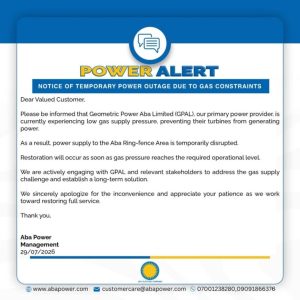
According to FENRAD, the blackout began at about 6:30 p.m. on July 31 following a disruption in natural gas supply to the 188-megawatt Geometric Power Plant in Osisioma Industrial Layout. The outage has since plunged the nine local government areas within the Aba Ring-Fence into darkness, disrupting businesses, manufacturing, healthcare services, schools and other essential sectors.
While acknowledging Geometric Power’s role in improving electricity supply in Aba over the years, the group said the latest outage exposed the vulnerability of a system that depends on a single electricity provider.
“FENRAD recognises the strategic importance of the Geometric Power Project in transforming electricity supply within Aba and appreciates the efforts made over the years to improve power reliability in the commercial hub,” Nwafor said.
However, the current situation once again exposes the vulnerability of a power system that depends on a single generation source and a single distribution structure without adequate redundancy or competitive alternatives.”
The organisation warned that the blackout is taking a heavy toll on Aba, one of Nigeria’s leading commercial and manufacturing centres, where thousands of businesses rely on steady electricity for production and service delivery.
“Every hour of blackout translates into lost productivity, increased operating costs through dependence on diesel and petrol generators, reduced incomes, and avoidable hardship for households and businesses already grappling with prevailing economic challenges,” the statement said.
FENRAD called on Heirs Energies, Aba Power, Geometric Power Limited, Nigerian Gas Marketing Limited (NGML), the Nigerian National Petroleum Company Limited (NNPCL), the Abia State Electricity Regulatory Agency (ASERA) and other relevant stakeholders to work together to restore gas supply and electricity without further delay.
Beyond the immediate crisis, the organisation urged regulators to address what it described as structural weaknesses in the Aba Ring-Fence electricity framework, arguing that the existing arrangement concentrates operational risks in a single provider.
“The current monopolistic arrangement within the Aba Ring-Fence electricity market limits consumer choice and concentrates operational risk within a single network,” Nwafor stated.
“Where a sole provider experiences a major technical or supply failure, millions of consumers are left without viable alternatives.”
FENRAD also called on the Nigerian Electricity Regulatory Commission, ASERA, the Federal Ministry of Power and the Abia State Government to review the Aba Ring-Fence electricity framework. It urged regulators to promote competition, strengthen consumer protection, improve regulatory oversight and encourage greater investment in electricity infrastructure.
The group further advocated increased investment in gas infrastructure, diversification of fuel supply sources, stronger transmission systems and effective contingency measures to prevent similar disruptions in the future.
“Communities should not repeatedly bear the burden of institutional and infrastructure deficiencies that can be addressed through sound planning, effective regulation, coordinated investment, and a competitive electricity market,” Nwafor said.