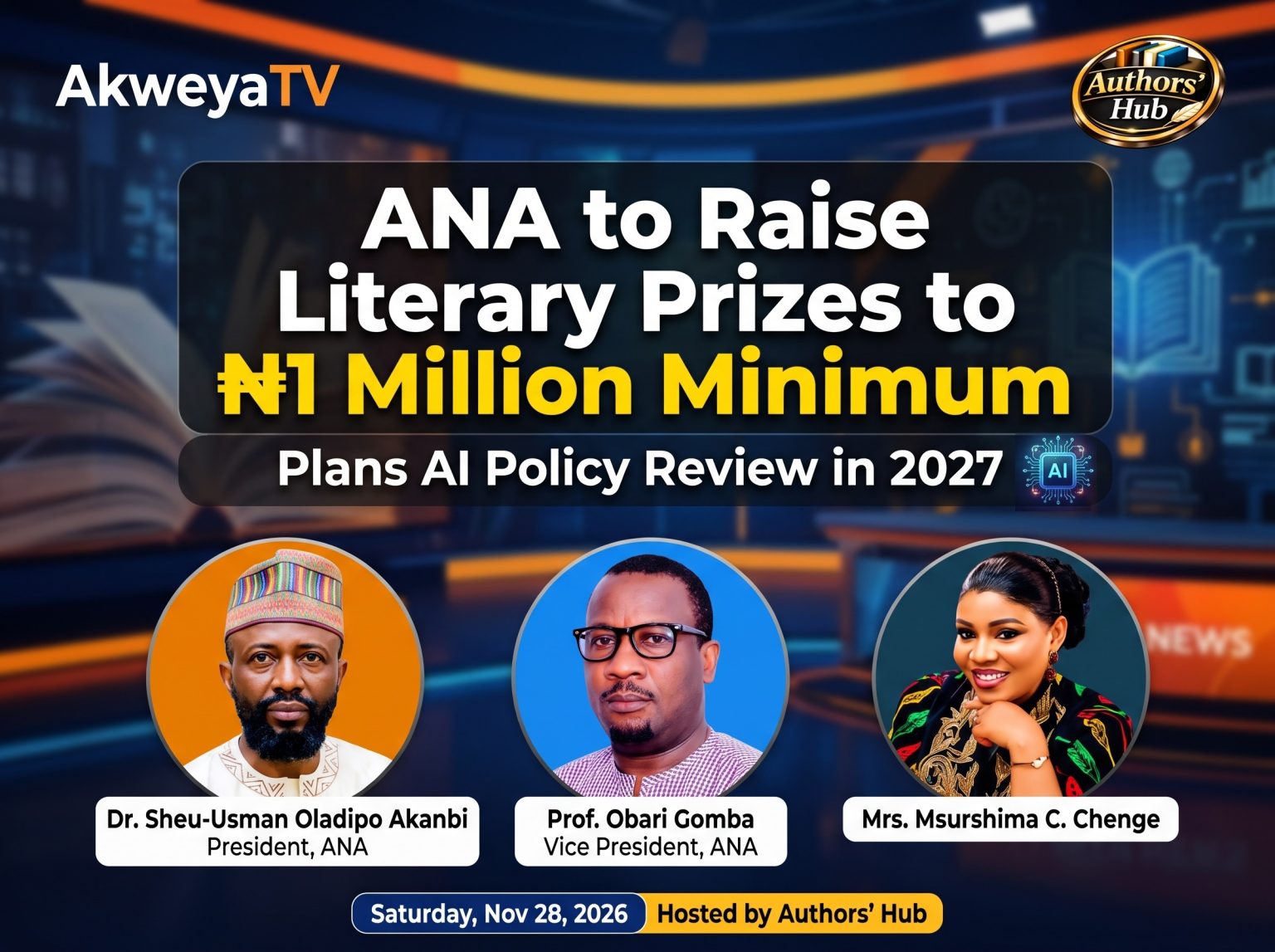

The Association of Nigerian Authors (ANA) has announced plans to raise the value of its annual literary prizes to a minimum of ₦1 million per category and convene a dedicated stakeholder engagement session in the first quarter of 2027 to establish formal guidelines on the use of Artificial Intelligence (AI) in creative writing.
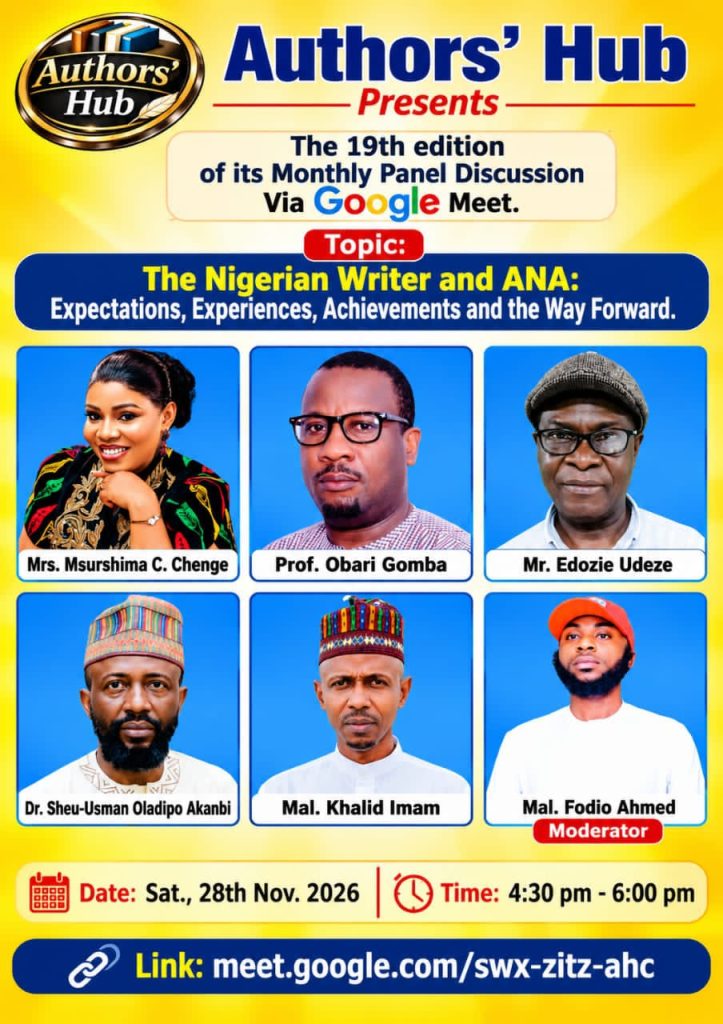
These proposals emerged during a virtual panel discussion hosted on Saturday, November 28, 2026, by the Authors’ Hub via Google Meet, in which AkweyaTV participated. The session, which drew approximately 50 participants, including writers, publishers, academics, and arts journalists, examined ANA’s leadership structure, institutional stability, and future direction across Nigeria’s literary ecosystem.
Credibility and Prestige of ANA Prizes
Speaking on efforts to elevate the credibility and prestige of ANA’s annual awards, the association’s Vice President, Professor Obari Gomba, stated that the National Executive Council (NEC) is working closely with donors and endowment partners to boost prize values.
“We believe that the prize money as it is now is too small,” Prof. Gomba said. “We want to ensure that we come to a point where none of our prizes is less than a million naira. If we cannot raise the money to award a million naira for any of the prizes, we are going to scale down the number of prizes to ensure that we put the best reward system in place.”
He added that ANA is strengthening its jury selection process, launching award publicity earlier in the year, and ensuring prompt disbursement of prize funds immediately after winners are announced.
AI in Nigerian Literature
Addressing growing concerns over AI-generated manuscripts and the reliability of AI detection tools in literary competitions, ANA President Dr. Usman Oladipo Akanbi disclosed that the association will dedicate its first-quarter engagement session in 2027 to deliberating on an AI policy framework.
- ANA Moves to Raise Literary Prizes to ₦1m Minimum, Plans AI Policy Review in 2027
- DEVELOPMENT INSIGHTS MORNING BRIEF, 27 NOVEMBER 2026
- Katsina Suspends Daura Emir Over Sexual Assault Allegation
- Why you will Remember Pete Edochie
- How AI Attacks Threaten Women’s Leadership
“I don’t want to give a definite statement on that AI aspect yet,” Dr. Akanbi said in response to a question from Authors’ Hub rapporteur Ikechukwu Salina. “The next engagement session we hold in the first quarter of next year, we will use it to deliberate so that we can get cross-cutting opinions.”
Reconciliation, Youth Inclusion, and Digital Overhaul
The webinar, hosted by Authors’ Hub founder Mallam Sumaila Isah Umaisha and moderated by poet Fodio Ahmed, also spotlighted ANA’s ongoing reconciliation drive following past post-convention rifts. Dr. Akanbi noted that the current administration has prioritised inter-chapter coordination, successfully bringing aggrieved state chapters such as Kano back into the fold.
Ahead of upcoming ANA elections, Prof. Gomba cautioned aspirants against ethnic, religious, or political polarisation, urging candidates to campaign strictly on creative merit and institutional integrity.
Contributing from the Kano State chapter, Mallam Khalid attributed member attrition to unrealistic expectations of instant grants or fame upon joining, alongside “sit-tight” leadership in some state chapters. To attract younger creatives, he urged ANA to overhaul its digital visibility, including launching an active website, hosting monthly virtual dialogues, and integrating contemporary genres like spoken-word poetry alongside traditional literary programmes.
Bridging the Publishing Gap
Publisher and author Mrs. Comfort Chenge emphasized the need for ANA to educate writers on the business of publishing, noting that many emerging authors do not understand the distinction between traditional publishing agreements and self-publishing. She called for stronger synergy among ANA, publishing houses, booksellers, book clubs, schools, the National Library, and the Reproduction Rights Society of Nigeria (REPRONIG) to ease book distribution challenges.
Arts journalist Mr. Udeze noted that while Nigerian literature commands strong international acclaim, with classic works translated into Portuguese, Spanish, and French, domestic media attention is often distracted by internal disputes. While Mr. Udeze and participant Abdulrahman Adebayo advocated rotating ANA’s annual conventions across states to stimulate cultural exchange, Dr. Akanbi explained that security concerns and logistics costs currently make the Mamman Vatsa Writers’ Village in Abuja more viable unless host state governments provide substantial backing.
Other contributors, including Dr. Awele Ilusanmi, President of the Literary Authors Cooperative (LITACO), and Umar Yogiza, urged state chapter executives to take proactive responsibility for member welfare, mentorship, and teamwork rather than leaving institutional growth solely to the national leadership