
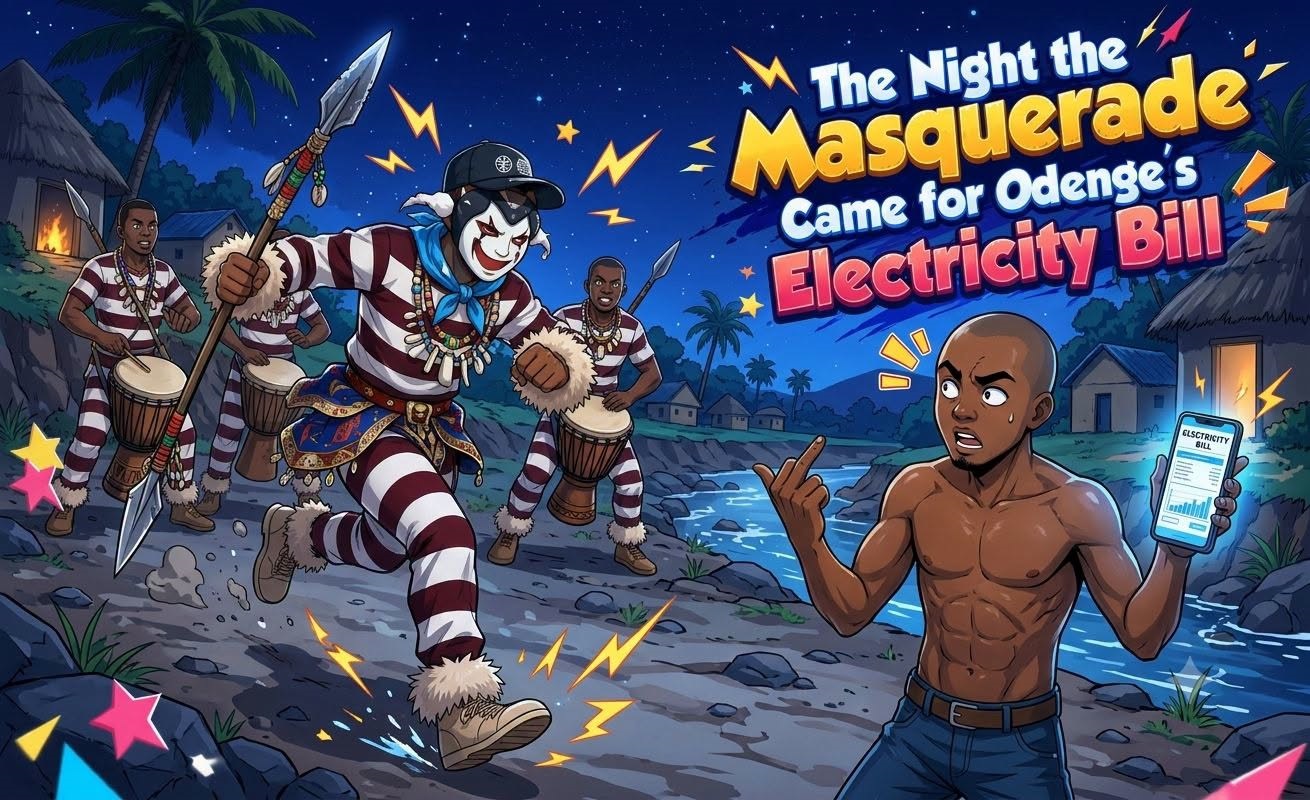

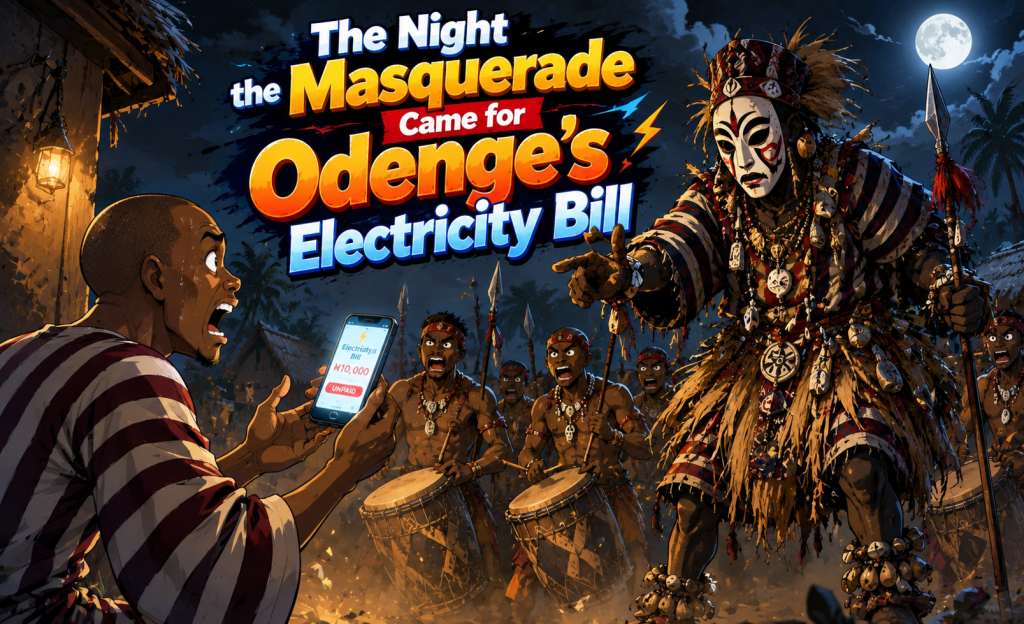
Everyone in Akweya knew the sound. Not every drum belonged to a festival.
Not every masquerade danced for celebration.
There was one masquerade whose drumbeat mothers prayed never to hear before dawn.
It appeared only when an important man had died. Women and children were forbidden to look upon it. Once its deep drums rolled through the trees at night, every family shut its doors, lowered its voices, and waited for sunrise.
So when Odenge awoke at exactly three o’clock one morning to the distant rhythm of gbum… gbum… gbum…, he sat upright on his mat.
His wife was already awake.
“Did you hear that?” she whispered.
The two children crawled closer to their mother.
“Papa… who has died?”
Odenge frowned.
“I don’t know.”
He searched his memory.
No town crier had gone through the village with announcement of someone’s passing.
No elder had announced a burial.
No important man had died.
Yet the drums were growing louder.
Gbum… gbum… gbum…
Odenge did not answer. He couldn’t voice what he knew. He hoped it was not true.
The sound rolled through the night like thunder climbing the hills.
His wife gripped his arm.
“If no one has died…”
Odenge did not answer. He couldn’t voice what he knew. He hoped it was not true.
He was listening.
Then the drums stopped.
The whole village fell silent.
A voice exploded outside Odenge’s homestead.
“Odenge!”
The walls seemed to tremble.
“We have come to collect your share of the electricity bill!”
Another beat of the drum.
Gbum!
“Pay today…”
Another beat.
Gbum!!
“…or pay forever!”
Odenge’s heart nearly escaped from his chest. The electricity company bills the entire village as one, then it is left for the community to collect a share the money from each family.
He knew what that meant. He was the head one of the families owing, and if the community is unable to pay, the electricity company was threatening to cut off power supply.
The masquerade would not leave until the debt was settled.
And while it danced through the village, trouble would multiply for Odenge.
Any wandering goat could become a feast.
Any chicken foolish enough to cross the path could become breakfast. Every animal eaten would be charged to Odenge.
Worse still, if the masquerade danced until sunrise, no one would go to the farms. No one would open a shop. The whole Akweya would lose a day’s work because of one man’s unpaid bill.
For years people would point at his family and say, “Those are the people who stopped Akweya from working.” That won’t be good for Odenge’s generation.
Outside, the drums began again.
Gbum… gbum… gbum…
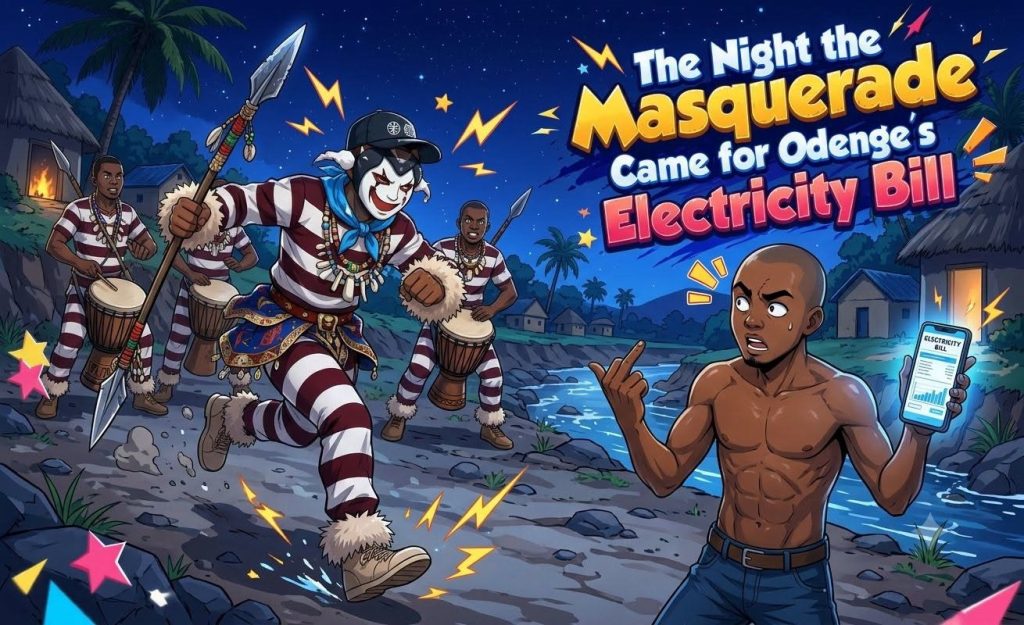
Then came another shout.
“Odenge! We are waiting!”
He grabbed his phone with shaking hands.
His share of the electricity bill was only seven thousand naira. He had planned to pay after selling his yams the following week. Now there was no next week.
He dialled his friend.
“No answer.”
He called another.
“My brother, please… lend me seven thousand. I’ll return it next market day.”
“I wish I could help,” came the sleepy reply. “I don’t have it.”
Another call.
Another apology.
Another promise that could not solve tonight’s problem.
Outside, the drums grew louder. Then he heard shouting. “Catch that goat!”
A terrified bleat pierced the darkness.
“Meeeeh!”
His wife covered her face.
“Our Daddy…”
He closed his eyes.
Too late.
A few moments later came cheers.
The unmistakable sound of a cooking fire being prepared drifted through the night.
His shoulders slumped.
“There goes somebody’s goat.”
The masquerade called again.
“Odenge!”
“Your bill is growing!”
He made more calls.
He begged.
He promised.
He even offered his wheelbarrow as collateral.
At last, just before dawn, one friend answered.
“I’ve sent the money.”
Odenge looked at his phone.
Six thousand naira.
He nearly cried with relief.
Without wasting another second, he picked up the one thousand naira note he had at home, added the transfer confirmation, and stepped cautiously outside.
The drumming stopped.
The masquerade stood in the middle of the compound, towering above everyone, its mask glowing in the light of burning torches.
Odenge bowed respectfully.
“I have come to pay.”
One of the attendants collected the money, confirmed the transfer that Odenge made, and nodded.
“The electricity bill has been settled.”
Odenge let out a long breath.
Then the attendant cleared his throat.
“There is one more matter.”
Odenge looked up.
“What matter?”
“The goat.”
“What goat?” Odenge feigned ignorance, even though he could smell the roasting meat.
“The one our ancestors enjoyed while waiting for you.”
The attendant pointed toward a worried neighbour.
“It belonged to him.”
Odenge swallowed.
“How much?”
“Forty thousand naira.”
His knees almost gave way.
“But… my bill was only seven thousand!”
The attendant shrugged.
“If you had paid seven thousand yesterday, you would not be paying forty-seven thousand today.”
The masquerade turned.
The drums sounded one final time.
Gbum… gbum… gbum…
Then the procession disappeared into the fading darkness.
As the sun rose over Akweya, the villagers returned to their farms, laughing quietly among themselves.
Whenever Odenge received an electricity bill after that day, he paid it before reading the rest of his mail.
And whenever anyone said, “I’ll pay it next week,” Odenge would shake his head and reply, “A small debt sleeps quietly. Leave it too long, and it wakes the whole village.”


