
Civil society urged to demonstrate measurable impact
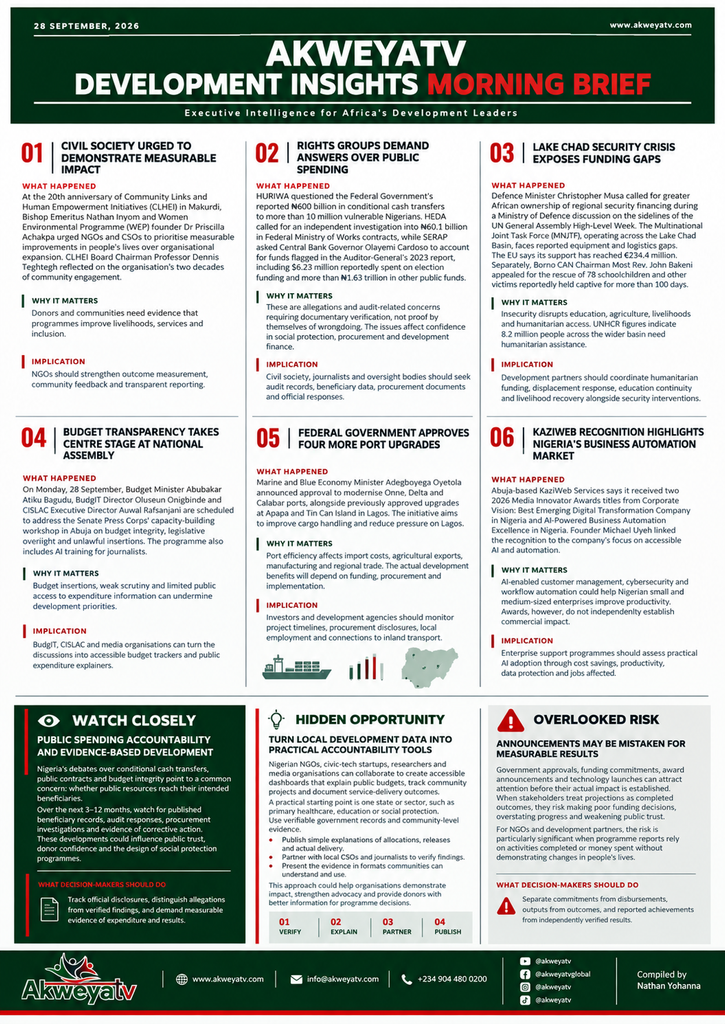
What happened: At the 20th anniversary of Community Links and Human Empowerment Initiatives (CLHEI) in Makurdi, Bishop Emeritus Nathan Inyom and Women Environmental Programme (WEP) founder Dr Priscilla Achakpa urged NGOs and CSOs to prioritise measurable improvements in people’s lives over organisational expansion. CLHEI Board Chairman Professor Dennis Teghtegh reflected on the organisation’s two decades of community engagement.
Why it matters: Donors and communities need evidence that programmes improve livelihoods, services and inclusion.
Implication: NGOs should strengthen outcome measurement, community feedback and transparent reporting.
Rights groups demand answers over public spending
What happened: HURIWA questioned the Federal Government’s reported ₦600 billion in conditional cash transfers to more than 10 million vulnerable Nigerians. HEDA called for an independent investigation into ₦60.1 billion in Federal Ministry of Works contracts, while SERAP asked Central Bank Governor Olayemi Cardoso to account for funds flagged in the Auditor-General’s 2023 report, including $6.23 million reportedly spent on election funding and more than ₦1.63 trillion in other public funds.
Why it matters: These are allegations and audit-related concerns requiring documentary verification, not proof by themselves of wrongdoing. The issues affect confidence in social protection, procurement and development finance.
Implication: Civil society, journalists and oversight bodies should seek audit records, beneficiary data, procurement documents and official responses.
Lake Chad security crisis exposes funding gaps

What happened: Defence Minister Christopher Musa called for greater African ownership of regional security financing during a Ministry of Defence discussion on the sidelines of the UN General Assembly High-Level Week. The Multinational Joint Task Force (MNJTF), operating across the Lake Chad Basin, faces reported equipment and logistics gaps. The EU says its support has reached €234.4 million. Separately, Borno CAN Chairman Most Rev. John Bakeni appealed for the rescue of 78 schoolchildren and other victims reportedly held captive for more than 100 days.
Why it matters: Insecurity disrupts education, agriculture, livelihoods and humanitarian access. UNHCR figures cited in the supplied report indicate 8.2 million people across the wider basin need humanitarian assistance.
Implication: Development partners should coordinate humanitarian funding, displacement response, education continuity and livelihood recovery alongside security interventions.
Budget transparency takes centre stage at National Assembly
What happened: On Monday, 28 September, Budget Minister Abubakar Atiku Bagudu, BudgIT Director Oluseun Onigbinde and CISLAC Executive Director Auwal Rafsanjani are scheduled to address the Senate Press Corps’ capacity-building workshop in Abuja on budget integrity, legislative oversight and unlawful insertions. The programme also includes AI training for journalists.
Why it matters: Budget insertions, weak scrutiny and limited public access to expenditure information can undermine development priorities.
- The Nigeria We Hope To See: From Hardship To Opportunity
- Tinubu Declares Nigeria Ready for Age of Prosperity
- As Nigeria Turns 66, Rev. Allam Champions Hope For A New Nigeria
- Nigeria At 66: Looking Back At Five Presidents Who Shaped Its Journey
- FG Releases Approved Textbooks for 2026–2028 Sessions
Implication: BudgIT, CISLAC and media organisations can turn the discussions into accessible budget trackers and public expenditure explainers.
Federal Government approves four more port upgrades

What happened: Marine and Blue Economy Minister Adegboyega Oyetola announced approval to modernise Onne, Delta and Calabar ports, alongside previously approved upgrades at Apapa and Tin Can Island in Lagos. The initiative aims to improve cargo handling and reduce pressure on Lagos.
Why it matters: Port efficiency affects import costs, agricultural exports, manufacturing and regional trade. The actual development benefits will depend on funding, procurement and implementation.
Implication: Investors and development agencies should monitor project timelines, procurement disclosures, local employment and connections to inland transport.
KaziWeb recognition highlights Nigeria’s business automation market

What happened: Abuja-based KaziWeb Services says it received two 2026 Media Innovator Awards titles from Corporate Vision: Best Emerging Digital Transformation Company in Nigeria and AI-Powered Business Automation Excellence in Nigeria. Founder Michael Uyeh linked the recognition to the company’s focus on accessible AI and automation.
Why it matters: AI-enabled customer management, cybersecurity and workflow automation could help Nigerian small and medium-sized enterprises improve productivity. Awards, however, do not independently establish commercial impact.
Implication: Enterprise support programmes should assess practical AI adoption through cost savings, productivity, data protection and jobs affected.
WATCH CLOSELY
Public spending accountability and evidence-based development
Nigeria’s debates over conditional cash transfers, public contracts and budget integrity point to a common concern: whether public resources reach their intended beneficiaries.
Over the next 3–12 months, watch for published beneficiary records, audit responses, procurement investigations and evidence of corrective action. These developments could influence public trust, donor confidence and the design of social protection programmes.
What decision-makers should do: Track official disclosures, distinguish allegations from verified findings, and demand measurable evidence of expenditure and results.
HIDDEN OPPORTUNITY
Turn local development data into practical accountability tools.
Nigerian NGOs, civic-tech startups, researchers and media organisations can collaborate to create accessible dashboards that explain public budgets, track community projects and document service-delivery outcomes.
A practical starting point is one state or sector, such as primary healthcare, education or social protection.
Use verifiable government records and community-level evidence.
Publish simple explanations of allocations, releases and actual delivery.
Partner with local CSOs and journalists to verify findings.
Present the evidence in formats communities can understand and use.
This approach could help organisations demonstrate impact, strengthen advocacy and provide donors with better information for programme decisions.
OVERLOOKED RISK
Announcements may be mistaken for measurable results.
Government approvals, funding commitments, award announcements and technology launches can attract attention before their actual impact is established. When stakeholders treat projections as completed outcomes, they risk making poor funding decisions, overstating progress and weakening public trust.
For NGOs and development partners, the risk is particularly significant when programme reports rely on activities completed or money spent without demonstrating changes in people’s lives.
Compiled by Nathan Yohanna
For more inquiries:
Website: www.akweyatv.com
Email: info@akweyatv.com
Phone number: +234 904 480 0200
YouTube: @akweyatv
Facebook: @akweyatvglobal
Instagram: @akweyatv
TikTok: @akweyatv