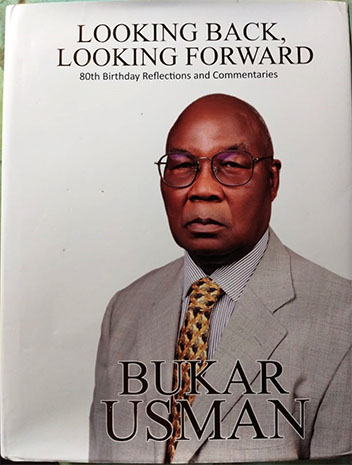

Dr Bukar Usman’s Looking Back, Looking Forward: 80th Birthday Reflections and Commentaries is more than a record of an individual’s life and achievements. It is an extensive collection of personal reflections, leadership lessons, historical accounts, correspondence and cultural documentation that offers insight into Nigeria’s public service, intellectual history and human relationships.
The book, which builds on Usman’s earlier autobiographical publications, Hatching Hopes (2006), My Literary Journey (2013) and My Public Service Journey (2019), was conceived to mark his 80th birthday on December 10, 2022. It also brings together his reflections on national and international issues, alongside messages, tributes and correspondence received from people whose lives and experiences have intersected with his.
- Looking Back on Bukar Usman’s Journey Through Public Service, Literature and Culture
- UNIJOS Makes History With Five Women Leaders
- Amnesty Demands Release of Detained Journalist Ojukwu
- FIJ Journalist Remanded Over Corruption Report
- When Africans Become Strangers In Africa: The Troubling Reality Of Xenophobia
According to the account presented in the book, friends, associates and family members made several attempts to persuade him to mark the milestone with a grand celebration. He declined, choosing instead to preserve the occasion in a publication that would remain available to future generations.
The decision reflects a recurring feature of Dr Usman’s intellectual work, his belief that experiences, conversations and historical moments deserve to be documented rather than left to memory.
A Lifetime Of Experiences And Leadership Lessons
The first part of the book contains three chapters devoted to the author’s reflections on leadership, Nigeria’s national circumstances and the international political system.
In the opening chapter, Dr Usman revisits lessons he learnt from his early years, particularly during his secondary school education and later professional engagements. He identifies accountability, fairness, teamwork, consultation and the recognition of excellence as essential qualities of effective leadership.
One important lesson from his school days was that leadership does not place anyone above the rules. He recalls an experience involving a former head boy who was removed for violating established regulations, an incident that helped shape his understanding of responsibility and accountability.
He also discusses the importance of considering different perspectives when dealing with disagreements. This ability, he explains, became particularly useful during his years in public service, when he had to interpret policies and manage engagements involving influential institutions such as the Nigeria Labour Congress (NLC) and the Academic Staff Union of Universities (ASUU).

His experiences at King’s College, Lagos, also helped him appreciate teamwork and collective responsibility, while his involvement in sports reinforced the importance of recognising and rewarding exceptional performance.
These early lessons eventually became part of his approach to public administration. Having joined the Federal Civil Service as a Clerical Officer, Dr Usman rose through the ranks to become a Permanent Secretary in the Presidency before retiring in 1999.
The chapter therefore offers more than a recollection of personal achievements. It provides practical reflections on how leadership principles developed through everyday experiences can influence professional conduct and public administration.
The second chapter examines Nigeria’s political, economic, security and cultural conditions.
Dr Usman considers the country’s persistent challenges, including the conduct of political elites and the difficulties confronting national development. However, his reflections also recognise the resilience of ordinary Nigerians and their continued desire to live together despite the country’s differences and difficulties.
His position places national unity within the context of shared interests, mutual understanding and the ability of citizens to look beyond divisions.
The third chapter extends the discussion to the international system, particularly the relationship between developing countries and industrialised Western nations.
The author examines the difficulties facing countries such as Nigeria as they navigate the consequences of colonialism, economic dependence and external political influence. His reflections raise questions about the ability of developing nations to determine their own development priorities while operating within an international system shaped by more powerful countries.
Together, these chapters connect personal experience with wider national and global concerns, giving the book relevance beyond the author’s individual journey.
The Human Stories Behind The Birthday Tributes
The second part of the book, which covers four chapters, shifts attention from the author’s reflections to the people and relationships that have shaped his life.
It contains goodwill messages, birthday tributes, personal correspondence, acknowledgements, requests made to the author and his foundation, and responses to several communications received.
The collection is particularly interesting because of the diversity of its contributors. People from different ethnic, religious, professional, social and generational backgrounds are represented, reflecting the range of relationships Dr Usman has developed through his years in public service, literature and cultural engagements.
Many of the messages go beyond conventional birthday congratulations. They offer accounts of the author’s influence on individuals, institutions and communities, providing readers with an opportunity to understand his contributions through the experiences of others.
The inclusion of these messages also reveals an unusual aspect of Dr Usman’s documentation practice. Rather than allowing personal correspondence to disappear after an exchange, he often preserves such communications in his publications, with appropriate acknowledgement.
This approach gives the book a distinctive human dimension. It recognises that history is not made up only of major political events, official decisions and public achievements. It is also shaped by conversations, relationships, shared ideas and the everyday interactions between people.
By preserving these exchanges, the author gives recognition to individuals whose words and experiences might otherwise have remained private or been forgotten.
It also allows readers to see how a person’s influence can be understood through the memories and testimonies of others.
Preserving Literature, Culture And Historical Records
The book’s appendices further expand its documentary value.
They contain published reviews of Dr Usman’s works, reviews he has written about other authors’ publications, additional birthday tributes, interviews, songs and ethnographic reports in both English and Hausa.
This section provides a broader picture of the author’s literary engagements and his relationship with other writers, researchers and cultural practitioners.
It also demonstrates that his intellectual interests are not limited to documenting his own experiences. He reads, evaluates and engages with the works of others, creating a record of literary conversations and shared interests.
The inclusion of materials in Hausa is particularly important in the context of his longstanding commitment to indigenous languages, oral traditions and cultural preservation.
Recognising Achievements Beyond The 80th Birthday
The postscript concludes the book with updates on the author’s activities and notable engagements following his 80th birthday in 2022.
Among the developments documented is his conferment with the Honorary Fellowship of the Nigerian Academy of Letters (HFNAL) in 2024.
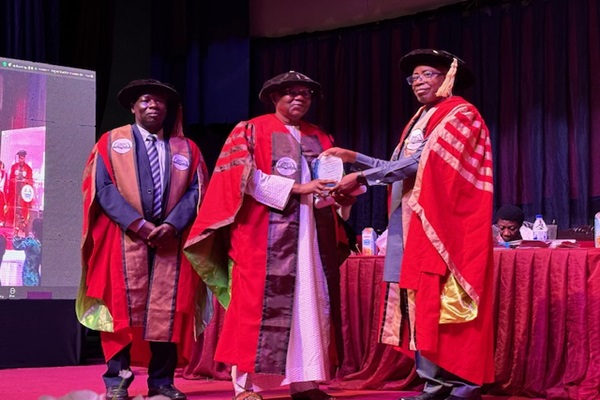
The section also records his participation as a keynote speaker at literary, oral literature and folklore conferences, alongside interviews, essays and commentaries examining his contributions and the significance of the honour bestowed on him by the Academy.
A Hausa language section presents many of the important details contained in the English version, further reinforcing the author’s interest in making cultural and intellectual materials accessible through indigenous languages.
This bilingual approach is consistent with his broader commitment to promoting Hausa literature and ensuring that indigenous knowledge remains part of Nigeria’s contemporary intellectual conversation.
A Reference Work Beyond Autobiography
In its entirety, Looking Back, Looking Forward: 80th Birthday Reflections and Commentaries brings together several forms of writing and documentation, including autobiography, biography, correspondence, philosophical reflections, ethnographic studies, literary and cultural criticism, poetry, songs, linguistic analysis and photographs.
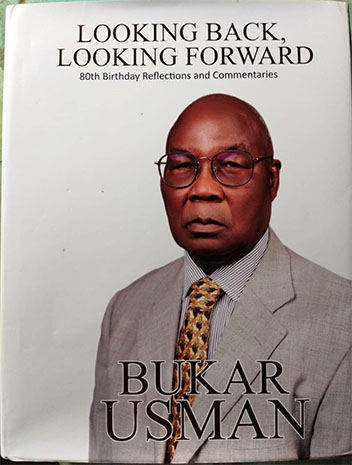
Its extensive coverage makes it a publication that readers may need to approach in stages rather than attempt to absorb in a single reading.
The book’s value lies partly in the range of materials it preserves. Researchers interested in public administration, Nigerian history, leadership, literature, folklore and cultural studies will find different areas of relevance within its pages.
It also provides an opportunity to examine the author’s intellectual development, professional experiences and relationships with people from different backgrounds and fields of knowledge.
Rather than presenting a single, uninterrupted account of his life, the publication allows readers to understand his journey through his own reflections and the contributions of others.
A Legacy Of Service, Scholarship And Cultural Preservation
Born on December 10, 1942, in Biu, Borno State, Dr Bukar Usman attended King’s College, Lagos, before proceeding to Ahmadu Bello University, Zaria, where he obtained a degree in Public Administration and International Relations in 1969.
His career in the Federal Civil Service spanned several decades, culminating in his appointment as Permanent Secretary in the Presidency. Following his retirement in 1999, he devoted considerable attention to creative writing, cultural research and the preservation of Nigerian folklore.
His contributions have earned him recognition from several institutions, including the Linguistic Association of Nigeria, Ahmadu Bello University, the University of Nigeria, Nsukka, the Ranar Mawakan Hausa Foundation and the National Museum of Burkina Faso, which recognised him as Jakadan Adabin Hausa (Ambassador of Hausa Literature).
For more news, stories and updates, visit: https://www.akweyatv.com/