


A 3,000-year-old gold bracelet once worn by an ancient Egyptian pharaoh has been irreversibly lost to history after being melted down by a gold smelter, Egyptian authorities announced Wednesday, following the arrest of four suspects in a theft ring.
Thank you for reading this post; don't forget to subscribe to our YouTube channel here!
The artefact, which belonged to Pharaoh Amenemope, who ruled during Egypt’s Third Intermediate Period, was stolen from a restoration lab at Cairo’s Egyptian Museum earlier this month and sold through a chain of dealers before being destroyed for its raw gold value.
Discovery and Investigation
Museum staff discovered the bracelet missing last week during an inventory process for artefacts being prepared for international shipment. Egyptian officials immediately launched an investigation, circulating photos of the stolen piece among law enforcement and archaeological authorities while a special committee conducted a full inventory of the conservation lab.
The Interior Ministry’s September 18 announcement revealed the artefact’s tragic journey from the museum to destruction. Investigators determined that a museum restoration specialist initially stole the bracelet, selling it to a silver trader who then passed it to a jewellery workshop owner. The workshop owner ultimately sold the piece to a gold smelter who melted it down, eliminating any possibility of recovery.
Archaeological Significance Lost
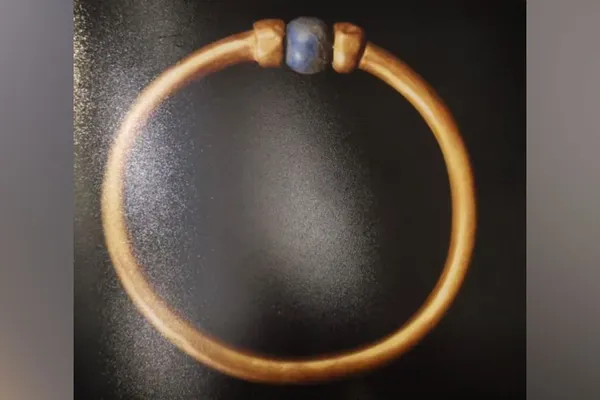
The simple gold band, decorated with a single spherical lapis lazuli bead, represented far more than its modest appearance suggested. According to Egyptologist Jean Guillaume Olette-Pelletier, while the bracelet was “not the most beautiful,” it was, “scientifically, one of the most interesting” pieces in the collection.
The artefact held deep cultural significance, crafted from materials the ancient Egyptians considered sacred. Gold represented the “flesh of the gods” in Egyptian belief, while lapis lazuli symbolised the gods’ hair, making the bracelet’s destruction particularly devastating from an archaeological perspective.
Part of Royal Collection
The bracelet formed part of Pharaoh Amenemope’s funerary collection, discovered in 1940 by French Egyptologist Pierre Montet in Tanis’ royal necropolis in the Nile Delta. Amenemope ruled during Egypt’s 21st Dynasty, part of the Third Intermediate Period that lasted from around 1076 to 723 B.C.E.
The Tanis collection at the Egyptian Museum features approximately 2,500 ancient objects, including gold funerary masks, silver coffins, alabaster jars and various jewels from the royal tombs. Amenemope’s funerary mask was prominently displayed in the touring “Ramses the Great and the Gold of the Pharaohs” exhibition during 2022 and 2023.
Criminal Enterprise Exposed
The investigation revealed a sophisticated network that moved the stolen artefact through multiple hands before its destruction. Forensic archaeologist Christos Tsirogiannis had warned that stolen artefacts typically face three possible fates: smuggling to auction houses with forged provenance, sale to private collectors, or melting for raw materials.
While melting down the artefact proved less profitable than other options, it made the crime significantly more difficult to trace, exactly as investigators discovered in this case.
Legal Consequences Pending
Egyptian law treats artefact theft with extreme severity, particularly when smuggling is involved. Stealing cultural artefacts with the intent to smuggle carries penalties of life imprisonment and fines up to $100,000. However, authorities have not yet announced specific charges against the four arrested suspects.
The case indicates ongoing challenges facing Egyptian cultural institutions in protecting their vast collections of priceless artefacts. The Egyptian Museum houses thousands of irreplaceable pieces spanning millennia of civilisation, making security and staff integrity critical concerns for preserving the nation’s archaeological heritage.
The loss is not just about the destruction of a valuable artefact, but the permanent elimination of a tangible connection to ancient Egyptian royalty and religious beliefs that had survived for three millennia until this month.
Follow the AkweyaTV channel on WhatsApp: http://bit.ly/3I7mQVx
Or scan the QR code:


