
Akwa Ibom State Government says its education strategy goes beyond examination results, pointing to billions of naira in budgetary allocations, school infrastructure, examination support and scholarships as evidence of its continuing effort to expand educational opportunities for young people.
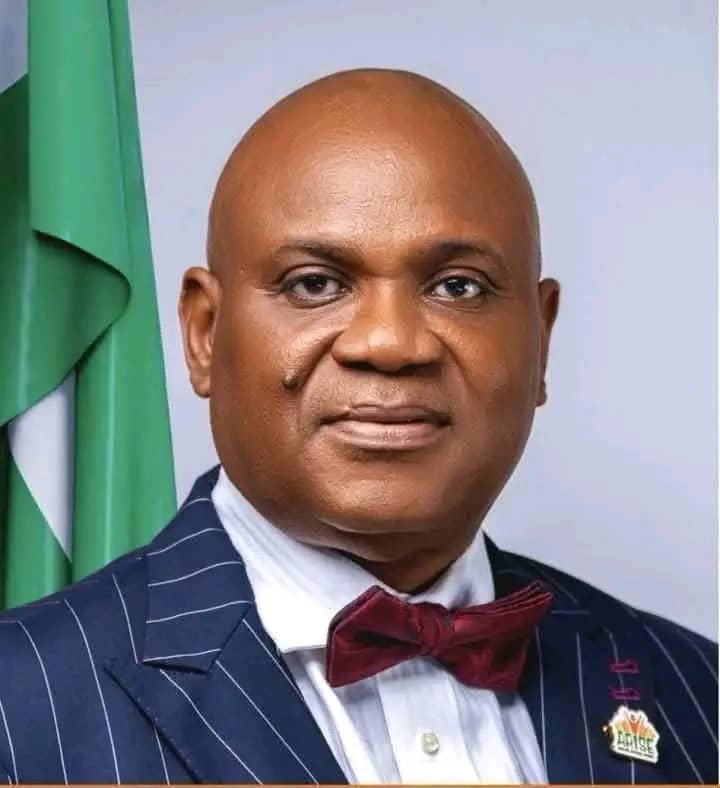
The State Commissioner for Information, Rt. Hon. Aniekan Umanah, disclosed the figures while responding to controversy surrounding a report that purported to place Akwa Ibom among the lowest-performing states in the 2026 National Examinations Council (NECO) results.
The controversy followed the release of the 2026 NECO Senior School Certificate Examination results on September 24. NECO said 1,371,992 candidates sat for the examination, with 804,948 — 58.67 per cent — obtaining five credits and above including English Language and Mathematics.
Umanah rejected the suggestion that Akwa Ibom’s overall performance could already be conclusively determined, explaining that results from 83 of the state’s 214 public-school examination centres remain outstanding.
He said the National Examinations Council was still carrying out sorting and verification relating to the statutory accreditation status of the affected centres. Until that process is completed and the outstanding results released, he maintained, a final assessment of Akwa Ibom’s state-wide performance would be premature.
The Commissioner also challenged the accuracy of the performance chart used in the report that triggered the controversy. He said the chart was not an official NECO document.
The distinction is significant because NECO’s published 2026 results show Kano, Lagos and Oyo leading the state-level figures under the five-credit benchmark, rather than the Abia, Ebonyi and Ekiti ordering presented in the disputed chart.
- NGO Advances Clean Energy for Women
- NGO Unites Young Women for Credible Elections
- Pharmacists Call For Bigger Role In Nigeria’s Healthcare System
- Every Step Brings Hope For Children
- The Nigerian Bar Association Raises Alarm Over Plateau Attacks
Beyond the immediate controversy, Umanah drew attention to what he described as the State Government’s broader education intervention.
He said the 2026 approved budget contains more than ₦35 billion for education, while ₦5.9 billion has been released to the State Universal Basic Education Board for intervention projects covering 2025 and 2026.
The government, he added, is constructing model primary schools across the state, paying bursaries and covering examination fees for students taking Placement Examination, BECE, NABTEB and WASSCE.
The support, according to Umanah, also extends to students pursuing higher education. He cited Governor Umo Eno’s recent approval of full overseas tuition support for a young graduate seeking a master’s degree abroad, alongside an earlier scholarship for a young law graduate from the Government Children’s Home to undertake postgraduate studies overseas.
These interventions, the Commissioner said, demonstrate the administration’s effort to combine infrastructure, financial assistance and individual educational opportunities.
For Akwa Ibom, therefore, the current NECO debate is not yet the final chapter. With 83 centres still awaiting results, the state’s eventual 2026 performance remains subject to the release and verification of the outstanding results.
Umanah consequently urged the public to rely on NECO’s verified data when assessing the state’s performance, while stressing that the administration remains committed to expanding access to education and creating opportunities for young people.