
As Nigeria moves closer to the 2027 general elections, religious leaders in Adamawa State are being encouraged to take a stronger stand against fake news, online propaganda and misleading information that could threaten peaceful coexistence.
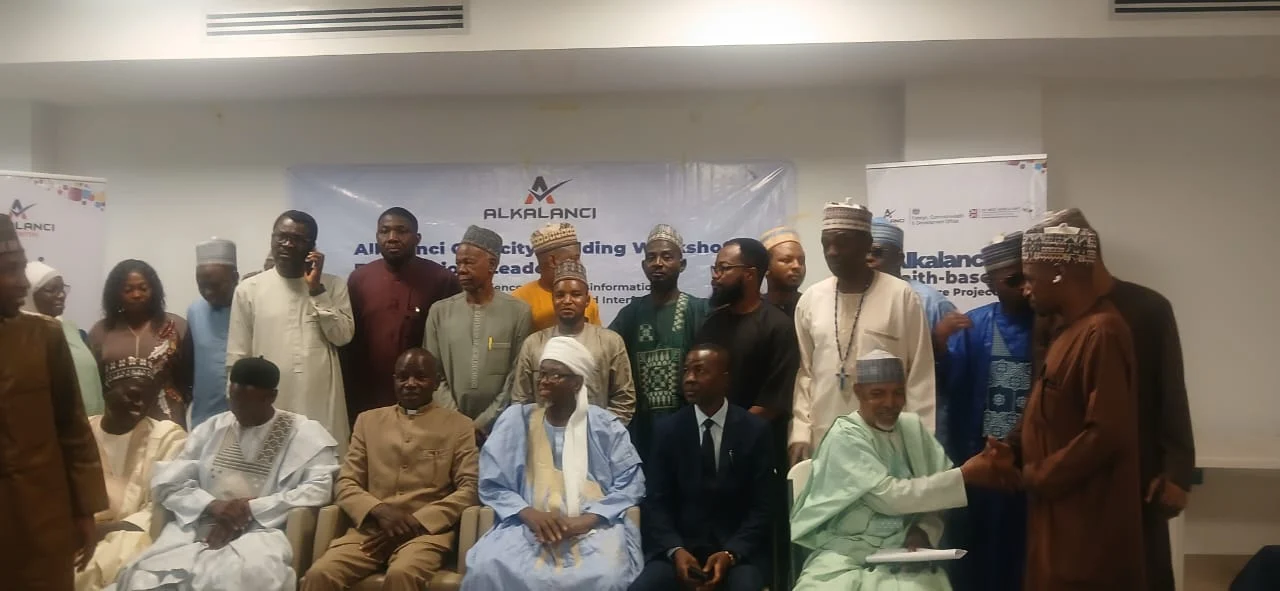
In a timely intervention, Alkalanci, a Non-Governmental Organisation (NGO), has trained 20 religious leaders in Yola to promote responsible information sharing and help communities recognise and resist disinformation.
The two-day workshop, held under the theme “Scaling Faith-Based Resilience Against Disinformation and Foreign Information Manipulation and Interference (FIMI),” was funded by the Foreign, Commonwealth and Development Office and ISF West Africa.
Ms Victoria Bamas, Programme Manager of Alkalanci, said the initiative was developed in response to the increasing speed at which false information circulates, particularly through digital platforms.

According to her, religious leaders were selected because their influence and credibility place them in a unique position to shape public attitudes and discourage the spread of harmful information.
She explained that the training follows a train-the-trainer model, allowing participants to return to their communities and share the knowledge acquired with their followers.
One major concern raised during the workshop was the growing financial motivation behind misinformation. Bamas observed that some individuals deliberately publish sensational or misleading content to attract online attention, advertising revenue and financial rewards.
This development, she warned, has made the fight against fake news even more challenging.
Supporting the initiative, Rev. Joel Manzo, Chairman of the Christian Association of Nigeria (CAN), Adamawa Chapter, described the training as an important step towards preventing community tensions.
He urged religious leaders to verify information before sharing it and use their positions to promote peace, reconciliation and unity among their followers.
He also emphasised that responsible communication should be regarded as both a civic duty and a religious responsibility.
Adding another important perspective, Malam Bappare Umar, State Secretary of Jama’atul Nasril Islam (JNI), Adamawa Chapter, highlighted the dangers of misinformation in a state with diverse ethnic, religious and cultural communities.
Umar warned that misleading messages could easily be manipulated to create divisions and trigger conflicts between communities.
With the 2027 elections approaching, he called on media practitioners and information activists to educate non-professional social media users on responsible information dissemination.
He also appealed for the training to be expanded to local government areas and wards to ensure that grassroots communities are not left behind.