
AI, Accountability & Citizens: Understanding Artificial Intelligence Through Real-Life Whistleblowing Stories
NEWS REPORT
Experts have called for responsible use of artificial intelligence (AI), stronger protection for whistleblowers and greater citizen participation in shaping policies governing the technology.
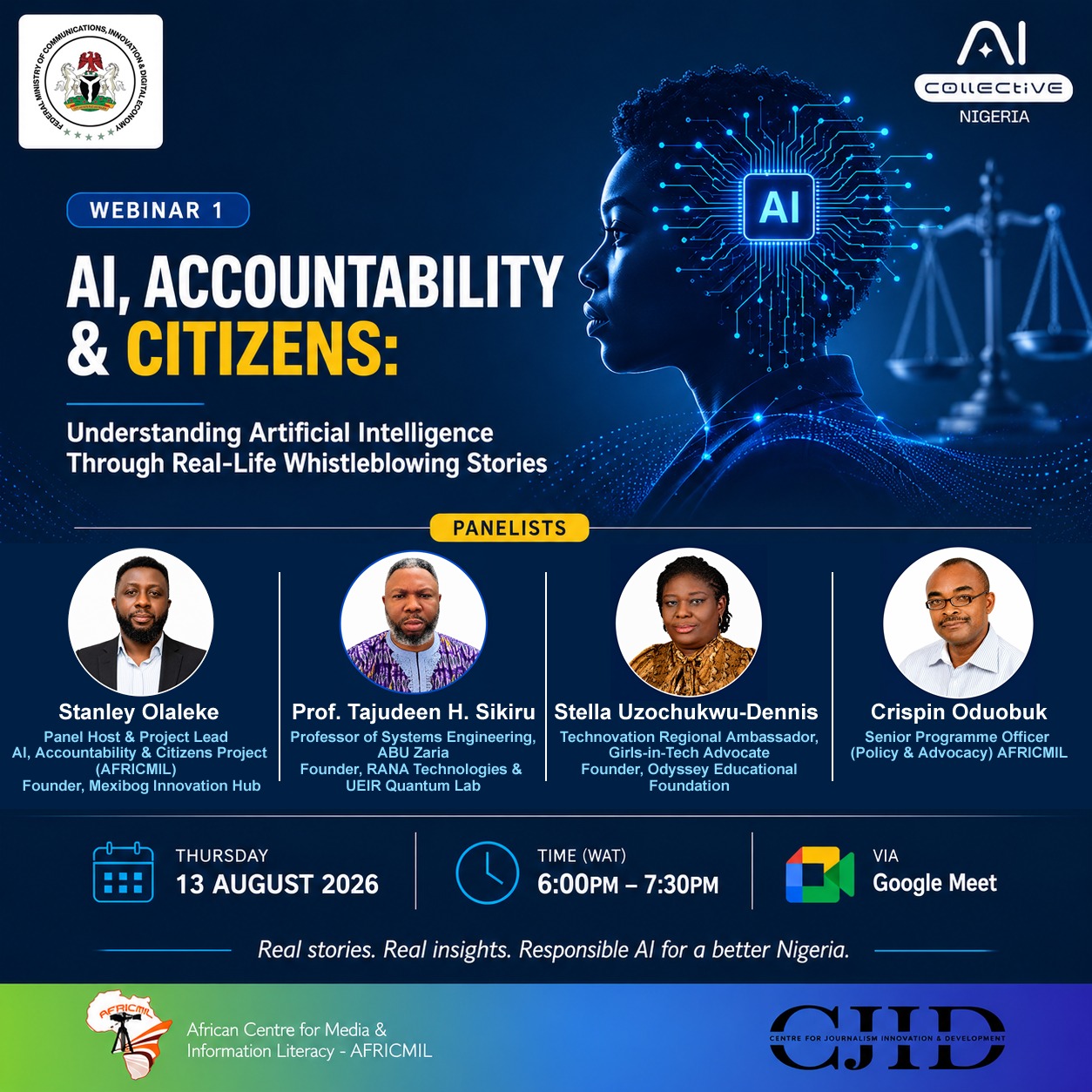
The call was made during the first webinar of the “AI, Accountability & Citizens” project, titled “Understanding Artificial Intelligence Through Real-Life Whistleblowing Stories,” held on Thursday, August 13, 2026, via Google Meet.
The webinar featured Stanley Olaleke, Panel Host and Project Lead of the AI, Accountability & Citizens Project, AFRICMIL, who is also the founder of Mexibog Innovation Hub; Prof. Tajudeen H. Sikiru, Professor of Systems Engineering, ABU Zaria and Founder of RANA Technologies & UEIR Quantum Lab; Stella Uzochukwu-Dennis, Technovation Regional Ambassador and Founder of Odyssey Educational Foundation; and Crispin Oduobuk, Senior Programme Officer, Policy and Advocacy, AFRICMIL.
Stanley Olaleke’s Practical AI Demonstration
During the webinar, Stanley Olaleke also gave participants a practical demonstration involving AI-generated and enhanced video content, using a screen recording to show how the technology could be applied to visual storytelling.

Screenshot from Stanley Olaleke’s screen-recorded AI video demonstration.
The demonstration formed part of the practical side of the session, helping participants see AI as a tool that can be used to create and enhance visual content rather than simply discussing the technology in theory.
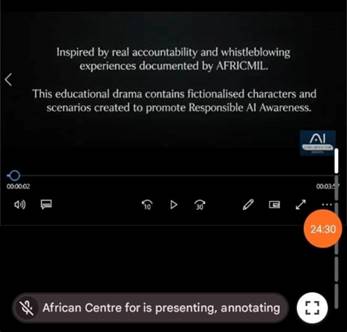
A screen from the AI video demonstration presented during the webinar.

Another frame from the screen-recorded AI video demonstration by Stanley Olaleke.
Panel Discussion
The discussion then examined AI from different perspectives, including privacy, legal responsibility, whistleblower protection, copyright and the role of citizens in AI governance.

Further visual from the AI video demonstration shown to participants.
Privacy and online safety
Stella Uzochukwu-Dennis urged young people to exercise caution over the information they provide online. She raised concerns about privacy policies and terms and conditions on digital platforms, noting that users may sometimes have limited choices when deciding whether to accept certain conditions before accessing software.
Uzochukwu-Dennis advised young people to be careful with personal information such as their phone numbers, home addresses and email addresses, while calling for greater internet awareness and education.
AI responsibility and ethical development
Prof. Tajudeen H. Sikiru said AI is a tool and that responsibility ultimately depends on the people who develop, deploy or use it.
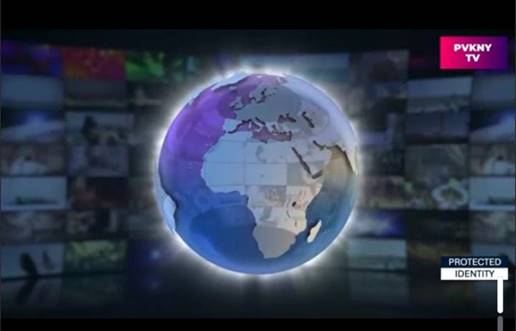
Additional frame from the AI video demonstration presented during the webinar.
He explained that users who rely on AI to generate an output have a responsibility for how that output is used, while developers also have an ethical responsibility to build systems that are beneficial to society and to communicate their limitations.
Prof. Sikiru cautioned users against treating AI as a replacement for human thinking, urging them to read, question and assess information generated by AI before relying on it. He also discussed the need for ethical rules and responsible AI development, pointing to international efforts to regulate the technology.
Whistleblower protection and citizen participation
Crispin Oduobuk said whistleblowing can carry significant risks because people who expose wrongdoing may face retaliation. He stressed that protecting the identity of whistleblowers is essential and expressed optimism that advances in technology could help make whistleblowing safer by strengthening identity protection.
Oduobuk also called for greater citizen participation in AI governance. He said citizens must remain engaged with the AI ecosystem and demand accountability, rules and policies governing how the technology is developed and used.
- AI Can Strengthen Accountability, But Human Oversight Remains Essential, Experts Say
- EXPERTS URGE RESPONSIBLE AI USE, STRONGER WHISTLEBLOWER PROTECTION
- Benue Journalists Get Training on Tackling SGBV
- DEVELOPMENT INSIGHTS MORNING BRIEF, 14 AUGUST 2026
- 9,500 Pharmacists Leave Nigeria Over Poor Pay, Working Conditions
Copyright, intellectual property and accountability
Stanley Olaleke highlighted legal and ethical concerns surrounding the use of published works and other data to train AI systems, noting that the matter is particularly important to journalists and media organisations whose content may be used in AI systems.
He stressed the need for greater attention to these emerging legal and accountability questions in Nigeria as AI becomes more widely adopted.
CLOSING REMARKS
In his closing remarks, Olaleke encouraged participants to continue the conversation through the learning platform and prepare for the continuation of the webinar.
He said participants should understand that AI is “neither a miracle nor a monster”, but a technology that requires balance, responsible institutions and informed citizens.
The organisers said the conversation will continue in the next session, with participants encouraged to ask questions and deepen their understanding of AI, accountability and its impact on society.