
By Praise Otor Peters and Aishat Omowumi Yekeen
The fight against corruption took centre stage on Thursday as experts and civil society representatives from different parts of the world gathered virtually for the Global Town Hall to discuss whether corruption can still be defeated in today’s increasingly complex world.
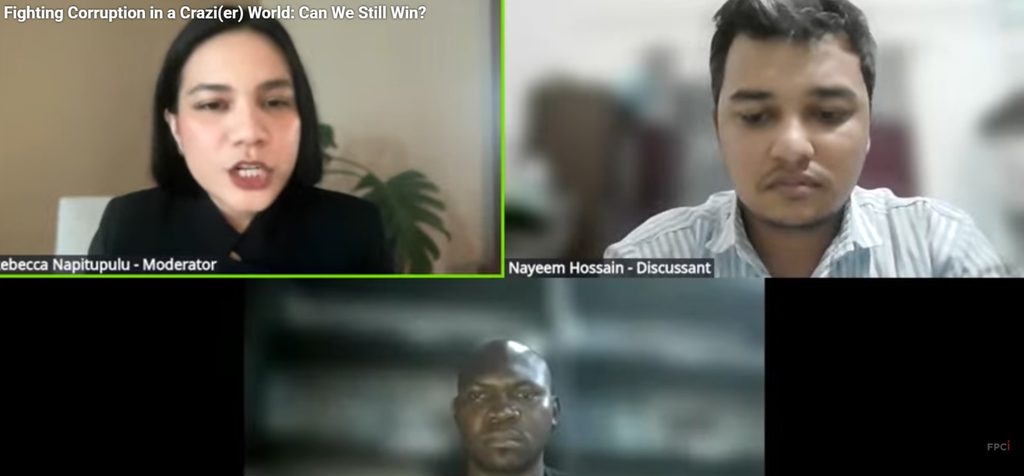
The session, held on September 10, 2026, from 10:00 a.m. to 11:25 a.m., was titled “Fighting Corruption in a Crazi(er) World: Can We Still Win?” It formed part of the annual Global Town Hall organised by the Foreign Policy Community of Indonesia (FPCI).
The discussion brought together different perspectives on how corruption affects societies and what can be done to tackle it.

Independent anti-corruption expert Drago Kos stressed that the fight cannot be won by governments or anti-corruption agencies alone. He called for stronger cooperation among institutions, civil society, citizens and other stakeholders.
“Collective actions are one of the futures of the fight against corruption.”
He also noted that while completely eliminating corruption may be difficult, countries can work towards reducing it to a level that does not seriously harm citizens and development.
For Nigeria’s David Alichenu Ekono, Anti-Corruption Programme Lead at the Center for Democracy and Development (CDD), the problem must be viewed beyond individual offenders.
“We should look at corruption holistically as a system.”
Ekono called for closer collaboration between anti-corruption institutions, civil society and investigative journalists. He also stressed the importance of asking what happens after stolen assets are recovered.
“Recovering an asset is not the same as returning public value.”
He urged institutions to focus more on preventing corruption by identifying weaknesses in systems before they are exploited.
From Bangladesh, Naim Hossain highlighted how corruption can become part of everyday life when people begin to see it as normal.
“Corruption is not only an institutional issue. It can also become a social challenge when people begin to accept it as normal.”
He called for stronger institutions, transparent systems, access to information and greater citizen participation. He also emphasised the role of civil society in helping communities understand their rights and demand accountability.
Meanwhile, Sri Lankan speaker Karu Jayasuriya argued that anti-corruption efforts must be sustained beyond political campaigns.
- ActionAid Raises Alarm Over Diphtheria Deaths In Abuja
- Bukar Usman Brings Biu’s History to Life
- ENTERTAINMENT INTELLIGENCE, 12 SEPTEMBER 2026
- Two Nigerians Killed In South Africa As Consulate Demands Justice
- Poetry, Play & Party to Bring Poetry, Theatre and Music Together in Abuja
“Anti-corruption must become a permanent system of government rather than a temporary political campaign.”
The discussion, moderated by Rebecca Napitupulu, ended on a note of optimism. While the panel acknowledged that corruption is becoming more sophisticated, participants agreed that stronger institutions, collective action, transparency and citizen involvement can make a difference.
Napitupulu captured that optimism by saying:

“I believe we can, even though we might have a long way to go.”
The Global Town Hall discussion ultimately showed that the fight against corruption is a shared responsibility. Governments, institutions, civil society, journalists and citizens all have a role to play.
The message was simple: corruption may be difficult to eliminate completely, but with stronger systems and people willing to work together, the fight is far from over.