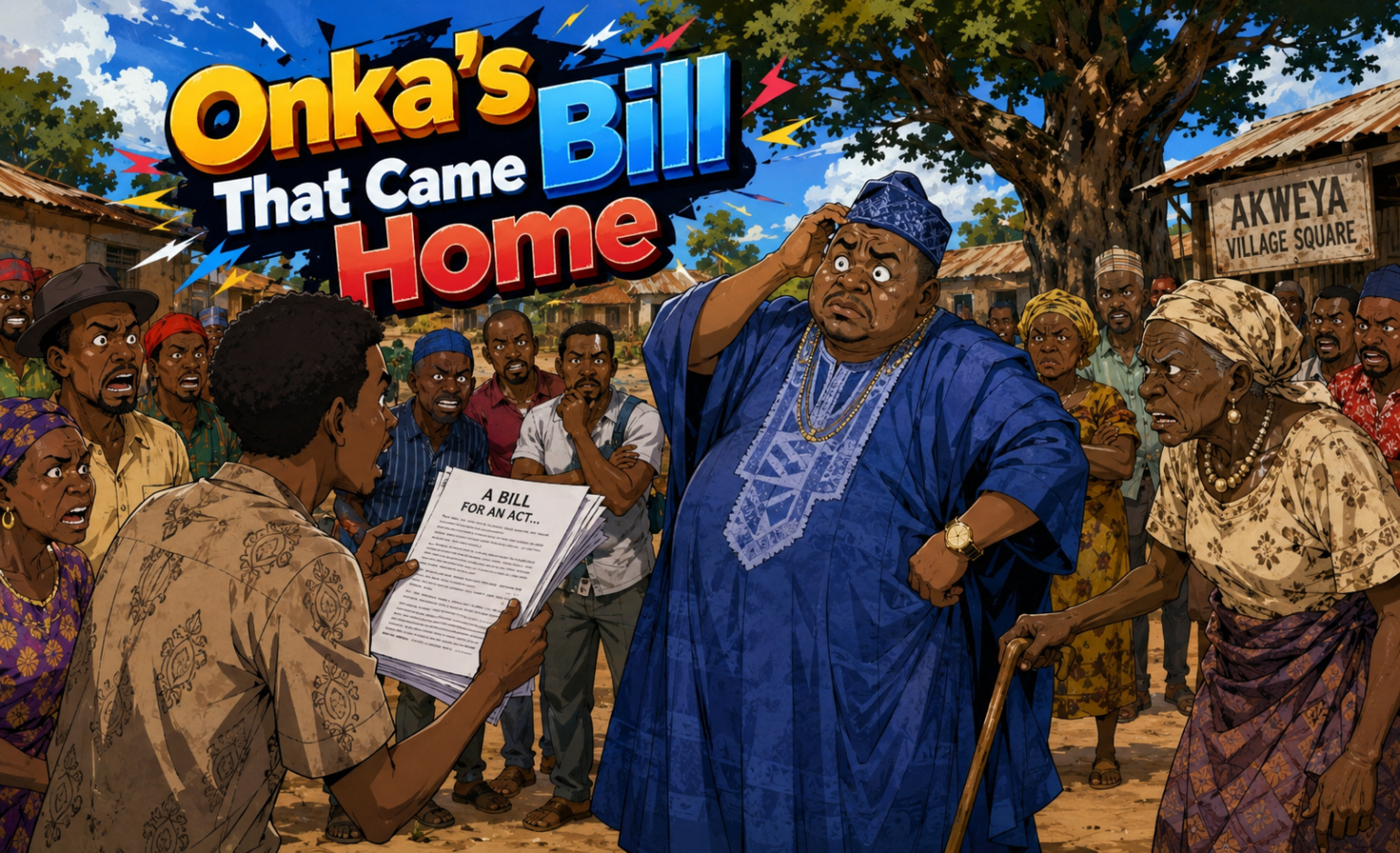

The first sign that Right Honourable Onka Agwuha was coming was not the siren. It was the hail of dust.
Three black SUVs rolled into Akweya land, trailed by a police pickup. Children ran after the convoy, mixing with the pall of dust like Elijah in the Bible about to leave for heaven. Women straightened their headscarves. Men abandoned their games of iche and draught beneath the mango trees.
By the time the convoy stopped in the village square, everyone was waiting. Hon. Onka stepped out smiling.
“Akweya kun Ofukwu!” he greeted, raising his right hand in the air.
The response was polite but restrained. A tense silence followed. Then old Mama Ooji tapped her walking stick on the ground.
“My son, Honourable,” she said, “Ainya obibi. Welcome. But when are you coming to complete your house and move into the village with us?”
“My… house? Which house, Mama?”
“The one you’ve been building for years like a tortoise.”
The crowd turned towards the slight elevation overlooking the square.
There it stood. A two-storey mansion with bare concrete walls. Rust had eaten through the exposed iron rods stretching into the sky. Grass climbed the staircase. Lizards had claimed the veranda long before the owner had. Every nostril would bend at the smell of goats that used the building as their hotel.
The house had a faded signboard still reading: FUTURE HOME OF HON. ONKA AGWUHA.
Onka laughed uneasily.
“We shall finish it… one day. You know money is hard to find in this country of ours.”
“No,” said Mama Ooji. “You will complete it and move in next week. You can sell one these your gigantic metals in wheels.”
He blinked.
“Next week?”
“After all,” she said, “they say your new law says you, our representatives, must live with us, the people you represent. Is your village too scary for you to live in? Are we wild animals now that you can no longer drink the water your mother used to bathe you in?
The smile disappeared from Honourable Onka’s face.
“My… what law?”
A ripple of laughter spread through the crowd.
From beneath the shade of the iroko tree, Odenge emerged carrying several printed pages.
“I downloaded the bill this morning.”
“You did what to what?”
“The bill. The one you propose, Sir. We follow it all on radio and Facebook.”
The villagers clapped.
“Read it!”
Odenge cleared his throat.
“A Bill for an Act requiring elected federal legislators to reside permanently in their constituencies except during officially scheduled legislative sittings…”
Applause.
Someone shouted, “Good law!”
Another added, “Now we’ll know whether our roads are truly good enough.”
“And health centre,” said a pregnant woman.
Odenge continued.
“…The National Assembly shall sit no more than four sessions annually…”
A trader nodded approvingly.
“Why should they stay in Abuja all year?”
But not everyone agreed.
A retired civil servant stood up.
“If Honourable stays here, won’t kidnappers target him?”
Another man replied, “Then he’ll understand why we can’t sleep.”
An elderly hunter added quietly, “When my grandson was taken on the Otukpo road, they said Honourable was attending a conference abroad.”
The square fell silent. Even Onka lowered his eyes.
Odenge resumed reading.
“…Where insecurity prevents a legislator from residing in the constituency, Parliament shall suspend sitting until adequate security has been restored…”
The silence broke into applause. Onka frowned.
“Who wrote this thing? This is definitely not from me!”
Slowly, Honourable Onka’s face turned towards his legislative aide.
The young man swallowed.
“Right Honourable, Sir, that was your submission at the public hearing… you asked for bold constitutional reforms.”
“I asked for reforms,” Onka snapped. “Not to relocate me back to the village.”
“But, Honourable,” the aide said softly, “you signed the final copy.”
“You mean…”
“You didn’t read it?”
Even the policemen exchanged glances.
Odenge smiled faintly.
“There is more.”
The villagers cheered again.
“…Legislators shall maintain their principal residence within their constituency and shall depend primarily on the public infrastructure available to their constituents…”
A young teacher raised her hand.
“So your children will attend our primary school?”
Another voice came from the back. “The health centre has no doctor.” It was the pregnant woman again.
“And electricity?” someone shouted. “We’ve had darkness for three weeks!”
The questions came faster than answers.
Children grabbed bottled drinks. Some bottles broke. Just like the arguments about constitutional reform that broke into arguments over who had collected two envelopes instead of one. Music erupted from portable speakers.
Onka raised both hands.
“My people… governance is not that simple.”
“No,” replied Mama Ooji. “It has simply never been this close.”
He looked helplessly at his legislative aide.
The aide avoided his eyes.
Finally, Onka leaned towards another assistant and whispered, “Do the other arrangement.”
A few minutes later one of the trucks in the convoy turned around and the booth flung open.
It was loaded. Not with documents. With crates of soft drinks. Bags of rice. Cartons of beer.
Odenge watched as the crowd surged toward it.
Then came the envelopes.
Someone threw crisp naira notes into the air.
The crowd surged in different directions, each person flying after each ₦500 note. Odenge observed it in slow motion like the strange occurrences in Indian movies.
Children grabbed bottled drinks. Some bottles broke. Just like the arguments about constitutional reform that broke into arguments over who had collected two envelopes instead of one. Music erupted from portable speakers.
In the confusion, the convoy engines roared to life.
The sirens wailed again.
As the SUVs sped away in a cloud of red dust, only Odenge remained in the square.
The pages of the bill lay scattered at his feet.
He bent slowly and gathered them.
A small boy, still wearing his faded school uniform, walked over.
“Egbrigyo Odenge…”
“Yes?”
“Can I have one copy?”
“What will you do with it?”
The boy slipped the folded pages into his exercise book.
“Our teacher says laws can change a country.”
Odenge looked towards the unfinished mansion. Then he watched the convoy disappear beyond the bend.
For the first time that afternoon, he smiled.
Perhaps the bill had finally found someone willing to read it.