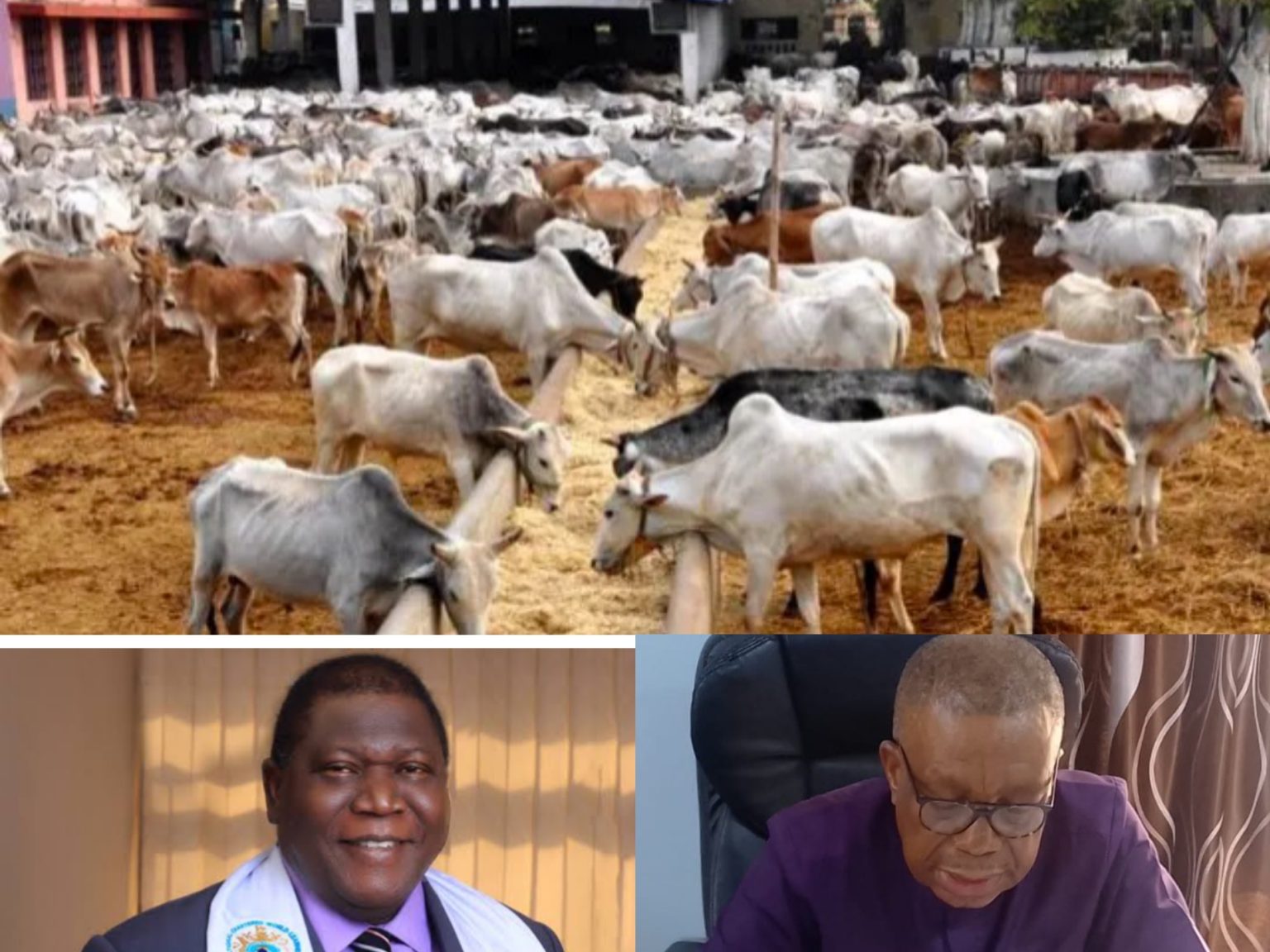

In a historic display of unity, the three apex sociocultural organisations of Benue State, the Mzough U Tiv (MUT), Ochetoha K’Idoma (OKI), and Omi Ny’Igede (ONI), have issued a joint position paper rejecting a decision to include Benue State in the pilot implementation of the Federal Government’s National Ranching Policy. The joint position paper was signed on 14 August 2026 in Makurdi, Benue State.
The announcement by the Minister of Livestock Development, Alhaji Idi Mukhtar Maiha, on 11 August 2026, that Benue was among six states selected for the pilot programme, has triggered a unified response from the three principal nationalities of the state, who describe the policy as a “resurrected RUGA” wrapped in new language.

Speaking at a press conference in Makurdi, Air Commodore Titus Agbecha (Rtd), President-General of Mzough U Tiv and Chairman of the Benue Socio-Cultural Organisations, declared that while the groups support the modernisation of Nigeria’s livestock sector through commercially viable ranching, they “object to what is being proposed under the guise of ranching: the permanent appropriation of ancestral farmland for ethnically exclusive pastoral settlements imposed by federal fiat.”
‘We Speak With One Voice’
The joint position paper, signed by Agbecha for MUT, Professor Yakubu Ochefu for Ochetoha K’Idoma, and Mr Daniel Omeno for Omi Ny’Igede, represents an unprecedented convergence of the state’s three major ethnic nationalities.
“We speak with one voice because this matter touches the foundations of our collective existence: the ancestral lands upon which our peoples have farmed for centuries, the constitutional framework that governs land administration in our federation, the physical security of millions of Benue citizens who continue to suffer the consequences of armed pastoral aggression, and the food security of a nation that depends disproportionately on Benue’s agricultural output.”
The groups insist they are “not opposed to progress” and “not opposed to livestock modernisation”. However, they argue that the policy, as currently designed, is structurally flawed, constitutionally problematic, and security-threatening.
‘No Consultation, Only Imposition’
A central grievance in the joint position paper is the complete absence of consultation with the very communities that would be affected.
The document notes that the Minister disclosed engaging “more than 34 pastoral organisations” and meeting pastoralist leaders under the Sultan of Sokoto, but conspicuously failed to consult farming communities, traditional institutions, state governments, or sociocultural organisations in the pilot states.
“In the specific case of Benue, the three apex sociocultural organisations — Mzough U Tiv, Ochetoha K’Idoma, and Omi Ny’Igede — were not consulted. The Tiv Traditional Council and the Idoma Traditional Council were not consulted. The Governor and the State House of Assembly were not consulted to our knowledge.”
The groups drew a sharp parallel with the rejected RUGA initiative of 2019, stating: “This pattern — consultation with pastoral interests, imposition on farming communities — is structurally identical to the RUGA approach that was rejected in 2019.”
‘A Ranch or a Town?’
The position paper raises a fundamental question about the true nature of the proposed “Renewed Hope Livestock Villages.”
According to the document, the Minister’s description of the programme reveals a critical conflation: the villages are described as providing housing, schools, primary healthcare centres, solar lighting, water infrastructure, veterinary clinics, mosques, markets, dairy processing facilities, and renewable energy systems.
“This is not a ranch. A ranch is an agricultural facility where livestock is kept and managed. What is described is a permanent human settlement, a town built around a livestock economy. The distinction is not semantic; it is existential.”
The groups warned that once established, these settlements “acquire demographic permanence” that generates claims to political representation, traditional authority, land expansion, and administrative autonomy — a trajectory they say has been documented in Southern Kaduna and parts of Niger State.
Security and Justice First
Perhaps the most emphatic demand in the joint position paper is that security and justice must precede any discussion of ranching in Benue.

“Benue State is not at peace. It is under siege,” the sociocultural associations said.
The document cites over 7,000 deaths since 2015, over 1.5 million internally displaced persons, and 17 of 23 local government areas affected, with ongoing attacks in 2026 in Agatu, Gwer West, Guma, Ohimini, and Otukpo LGAs.
The groups insist that before any ranching policy can be discussed in Benue, those responsible for killings and displacement must be identified, disarmed, arrested, and prosecuted; all internally displaced persons must be returned safely to their ancestral communities; and reparations must be paid for destroyed communities, farmlands, and livelihoods.
In their words, “The sequence matters: security and justice first, resettlement of the displaced second, reparations third, and only then, within a framework of state-led, law-compliant, voluntary, and commercially driven ranching, can livestock modernisation be discussed.”
Constitutional and Legal Objections
The joint position paper subjects the Federal Government’s policy to rigorous constitutional scrutiny, noting that land administration is vested in State Governors under Section 1 of the Land Use Act, Cap. L5, Laws of the Federation of Nigeria, 2004.
- Nigeria’s National Anthem: A Journey Through 66 Years
- Tinubu: Nigeria Is Moving Beyond Economic Hardship As Prosperity Beckons
- Behind the Scenes with Wonderman
- General Elvee Brings Gospel Reggae Vibes to Kristofarian Jam Session
- Rapture Man Celebrates Jesus Through Gospel Reggae
The groups argue that any Federal Government programme requiring the use of land within a state must comply with the Constitution, the Land Use Act, and existing state laws. They specifically cite Benue’s Open Grazing Prohibition and Ranches Establishment Law, 2017, whose constitutional validity was affirmed by the Federal High Court in Attorney-General of Benue State & Anor v. Attorney-General of the Federation & 2 Ors (FHC/MKD/CS/56/2019).
“Any federal ranching programme operating in Benue State must operate within and subordinate to this law. A programme that contradicts, undermines, or effectively nullifies a validly enacted and judicially upheld state law is not consistent with constitutional federalism.”
The Policy Genealogy: From Cattle Colonies to ‘Renewed Hope’
The groups document what they describe as a pattern of policy rebranding that has continued across administrations despite repeated public rejection.
“The lineage is unmistakable: Cattle Colonies (2018), Rural Grazing Areas/RUGA (2019), National Livestock Transformation Plan/NLTP (2019-2023), and now the National Ranching Policy with its ‘Renewed Hope Livestock Villages’ (2025-present).”
They warn that “the peoples of Benue State are not deceived by nomenclature. The substance of the policy, not its name, determines our response.”
An Alternative Framework
Rather than merely rejecting the policy, the groups have proposed a comprehensive alternative framework for livestock modernisation that is consistent with constitutional federalism and protective of farming communities.
Key elements of their proposal include: state-led implementation under Benue’s existing 2017 law; voluntary, private, commercial ranching; an inclusive livestock policy covering poultry, piggery, goat and sheep farming, aquaculture, and other sub-sectors beyond cattle; concurrent enforcement of the anti-open grazing law; community consent and benefit-sharing; and a security architecture that precedes economic development.
“The Federal Government’s role is to support the implementation of this law through funding, technical assistance, veterinary expertise, and security deployment, not to replace it with a competing federal framework. This is the constitutional model: the states legislate, the states administer, and the federal government assists.”
Nigeria’s Security Tied to Benue Security
As Agbecha put it: “Benue is the food basket of the nation. For Nigeria to be food secure, Benue farmers must first be secure on their land.”
The groups have given the Federal Government, the Benue State Government, and the Minister of Livestock Development a clear roadmap. Whether this historic unity translates into meaningful change will depend on whether Abuja is willing to listen, and whether Makurdi is willing to stand firm.