

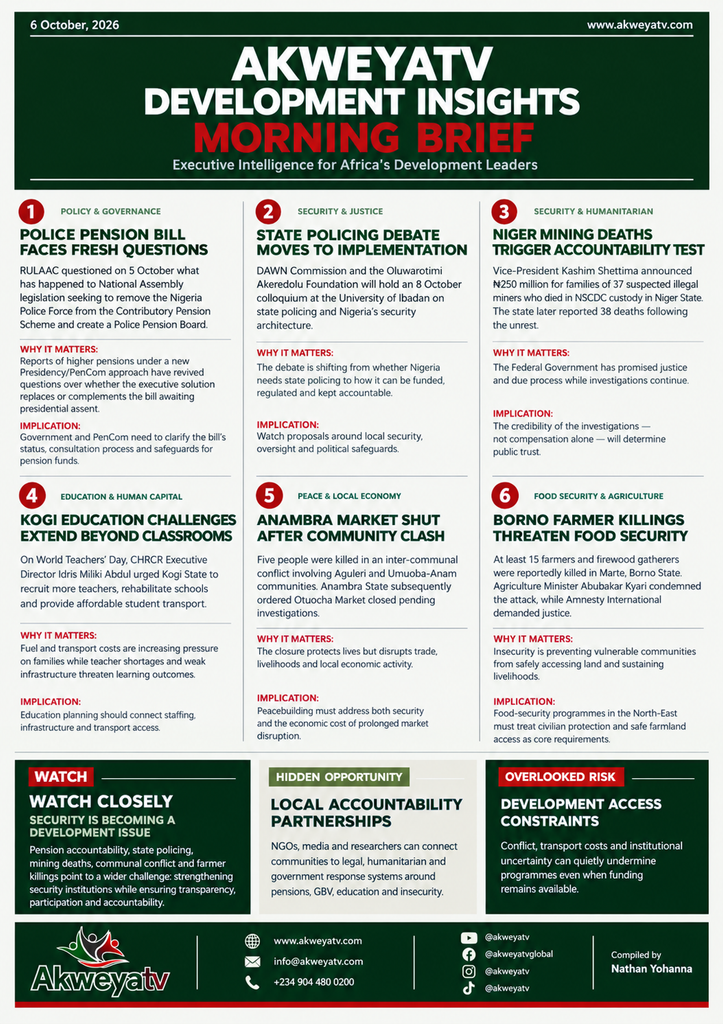
POLICE PENSION BILL FACES FRESH QUESTIONS
What happened: RULAAC on 5 October questioned the status of legislation already passed by the National Assembly to remove the Nigeria Police Force from the Contributory Pension Scheme and establish a dedicated Police Pension Board.
Who: RULAAC, President Bola Ahmed Tinubu, PenCom, the National Assembly and retired police officers.
Why it matters: Reports that President Tinubu has directed higher pensions for retired officers have revived questions over whether the executive approach replaces, complements or leaves unresolved the bill awaiting presidential assent.
Implication: Government and PenCom need to clarify the bill’s status, consultation process, fund management and safeguards against delays, deductions and mismanagement.
STATE POLICING DEBATE MOVES TO IMPLEMENTATION
What happened: The DAWN Commission and Oluwarotimi Akeredolu Foundation will hold an 8 October colloquium at the University of Ibadan on state policing and Nigeria’s security architecture.
Who: DAWN Commission, the Akeredolu Foundation, governors, lawmakers, security chiefs, traditional rulers, academics and civil society.
Why it matters: With banditry, kidnapping and attacks on communities continuing, the debate is increasingly shifting from whether Nigeria needs state policing to how it can be funded, regulated and held accountable.
Implication: Development and governance actors should watch emerging proposals around local security, oversight and political safeguards.
NIGER MINING DEATHS TRIGGER ACCOUNTABILITY TEST
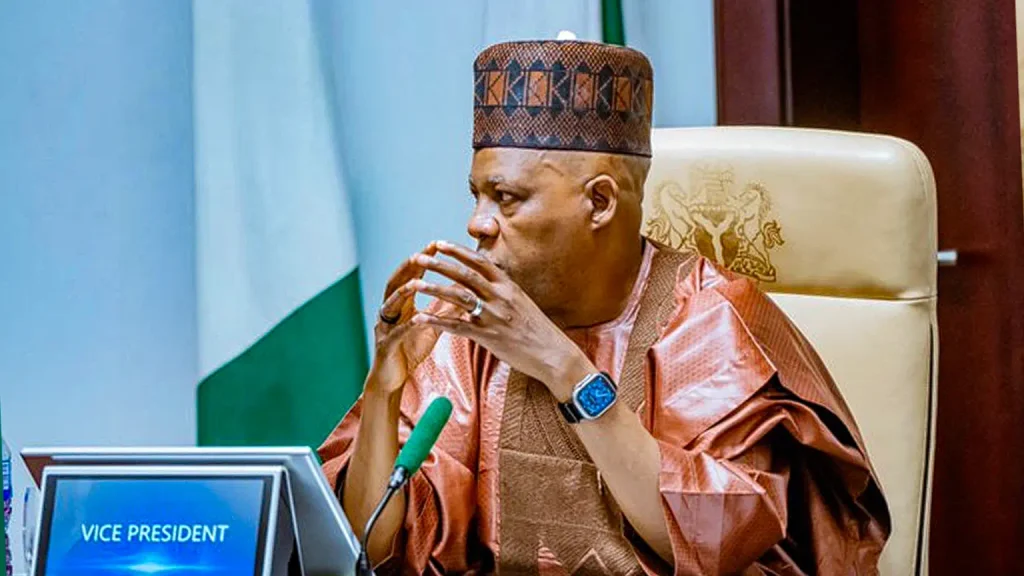
What happened: Vice-President Kashim Shettima announced ₦250 million in federal support for families of 37 suspected illegal miners who died in NSCDC custody in Niger State. The state says the toll later reached 38 after another death during the unrest.
Who: Vice-President Shettima, Governor Mohammed Umaru Bago, NSCDC and affected families.
Why it matters: The Federal Government has promised justice and due process, while investigations continue into the deaths and subsequent violence.
- Ten Ajegunle Students Get Equal Scholarship Opportunities
- Paradigm Initiative Equips Journalists Against Disinformation
- DEVELOPMENT INSIGHTS MORNING BRIEF, 14 OCTOBER 2026
- Akwa Ibom Brings Hope to Flood-Affected Families
- Scoliosis Patients Urged to Seek Emotional Support
Implication: The credibility of the investigations—not compensation alone—will determine whether public trust is restored.
KOGI EDUCATION CHALLENGES EXTEND BEYOND CLASSROOMS
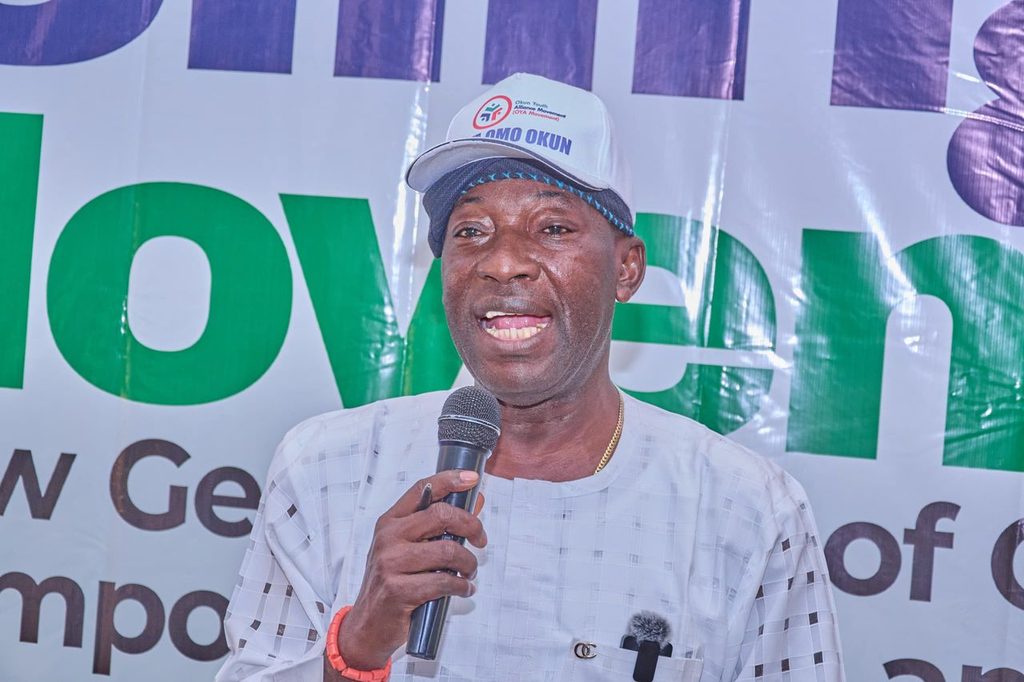
What happened: On World Teachers’ Day, CHRCR Executive Director Idris Miliki Abdul urged Kogi State to recruit more teachers, rehabilitate schools and provide affordable student transportation.
Who: CHRCR and the Kogi State Government.
Why it matters: Rising fuel and transport costs are adding pressure to families, while teacher shortages and weak school infrastructure could further limit learning outcomes.
Implication: Education planning should connect teacher recruitment, school rehabilitation and transport access rather than treating them as separate problems.
ANAMBRA MARKET SHUT AFTER COMMUNITY CLASH

What happened: Five people were killed in an inter-communal conflict involving Aguleri and Umuoba-Anam communities. Anambra State subsequently ordered the closure of Otuocha Market pending investigations.
Who: Governor Chukwuma Soludo, Deputy Governor Onyekachukwu Ibezim and the affected communities.
Why it matters: The closure protects lives but also interrupts livelihoods, trade and local economic activity.
Implication: Peacebuilding efforts need to address both security and the economic consequences of prolonged market disruption.
BORNO FARMER KILLINGS THREATEN FOOD SECURITY
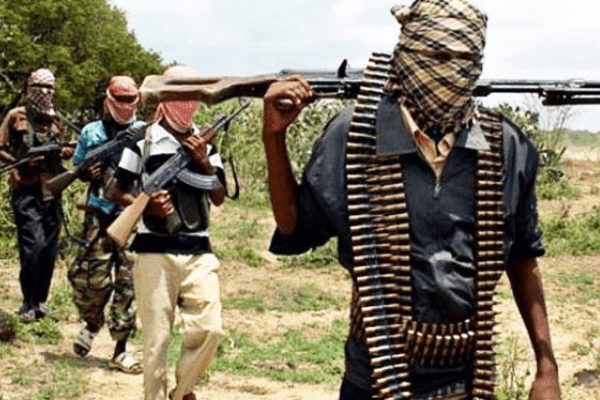
What happened: At least 15 farmers and firewood gatherers were reportedly killed in Marte, Borno State. Agriculture Minister Abubakar Kyari condemned the attack, while Amnesty International called for justice and stronger protection.
Who: Ministry of Agriculture and Food Security, affected farmers, Amnesty International and security authorities.
Why it matters: Insecurity is directly undermining farmers’ ability to access land, produce food and sustain livelihoods in one of Nigeria’s most vulnerable regions.
Implication: Food-security programmes in the North-East must treat civilian protection and safe access to farmland as core programme requirements.
WATCH CLOSELY
Security is becoming a development issue. Pension accountability, state policing, mining deaths, communal conflict and farmer killings all point to a wider challenge: strengthening security institutions while ensuring transparency, community participation and accountability.
HIDDEN OPPORTUNITY
Local accountability partnerships. NGOs, media and researchers can build community-level systems that connect citizens to legal, humanitarian and government response mechanisms around pensions, GBV, education and insecurity.
OVERLOOKED RISK
Development programmes may increasingly face security and access constraints. Conflict, transport costs and institutional uncertainty can quietly undermine projects even when funding remains available.
Compiled by Nathan Yohanna
For more inquiries:
Website: www.akweyatv.com
Email: info@akweyatv.com
Phone number: +234 904 480 0200
YouTube: @akweyatv
Facebook: @akweyatvglobal
Instagram: @akweyatv
TikTok: @akweyatv


