
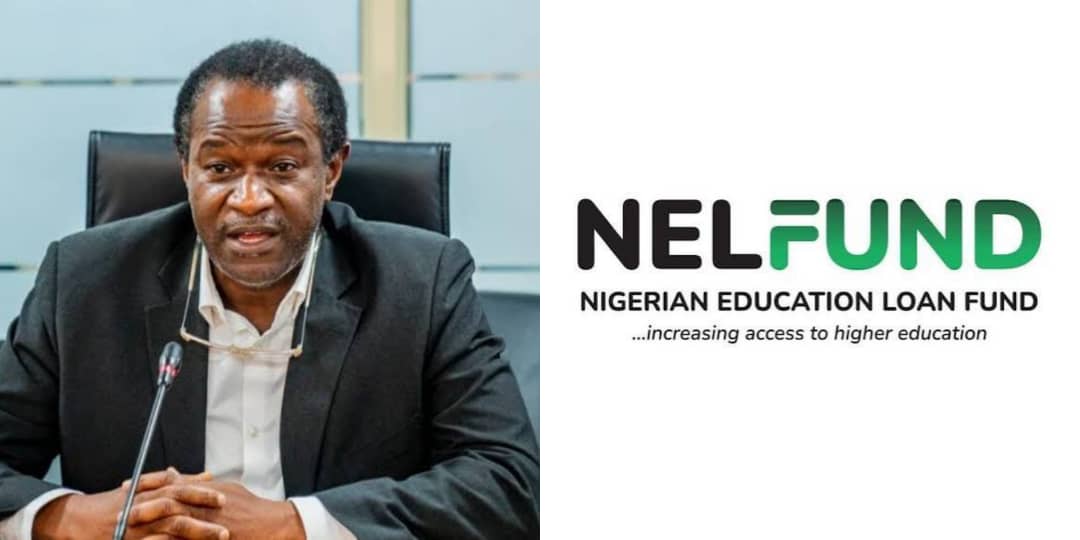

The Nigerian Education Loan Fund (NELFUND) is developing a verification portal to help parents confirm whether their children’s school fees have been paid through the student loan scheme. The fund’s Managing Director and Chief Executive, Akintunde Sawyerr, disclosed this to journalists in Abuja on Wednesday, October 28, 2026, explaining that the platform would allow parents to check payment records using their children’s matriculation numbers.
Portal to Address Undisclosed Loan Payments
Sawyerr said the portal was being developed to address concerns that some students continued to collect school fees from their parents despite having their tuition covered by NELFUND.
According to him, parents who enter their children’s matriculation numbers would be able to see whether the fees had been paid or remained outstanding. The initiative is intended to improve transparency and prevent students from receiving financial support for the same tuition expenses from both the fund and their families.
- DEVELOPMENT INSIGHTS MORNING BRIEF 30 OCTOBER, 2026
- Victor Ndulue’s Shadows Of Gunpowder Explores Ageing And Legacy
- NELFUND Moves to Curb Duplicate Tuition Payments
- CSOs Launch Election Data Platform Ahead of 2027 Polls
- FG Empowers 150 Enugu Youths With Future-Ready Skills
NELFUND Introduces Digital Wallet System
The verification portal comes as NELFUND develops a digital wallet system under its NELFUND 2.0 initiative to ensure approved tuition fees are paid directly to tertiary institutions.
Under the proposed arrangement, students would use a mobile application to authorise payments from their approved loan funds without the money passing through their personal bank accounts.
Sawyerr explained that the system would restrict payments to the designated institution, preventing beneficiaries from transferring the funds to personal accounts or using them to pay another school.
“The system, the token, not only can they not transfer it to their personal account, they can’t transfer it to any other school,” he said.

The initiative is also expected to address cases in which students pay their fees without knowing that NELFUND has already transferred the money to their institutions, as well as difficulties associated with obtaining refunds for duplicate payments.
NELFUND Executive Director Mustapha Iyal said the wallet-based payment system was undergoing pilot implementation. At the time of the briefing, more than 400,000 applications were in the system.
NELFUND Disburses ₦218.2 Million to Two Institutions
Meanwhile, NELFUND has disbursed ₦218.2 million to 3,575 students of the Federal College of Agriculture, Moor Plantation, Ibadan, Oyo State, and the Federal University of Education, Zaria, Kaduna State, to cover institutional fees for different academic sessions.
The Provost of the Ibadan institution, Professor Jonathan Atungwu, said ₦54.21 million was released to 360 students in four tranches between August 2025 and April 2026. The payments covered the 2024/2025 and 2025/2026 academic sessions.
Similarly, the Vice-Chancellor of the Zaria institution, Professor Yahaya Bunkure, confirmed that the university received ₦163.99 million in eight tranches between December 2025 and February 2026 to cover students’ registration fees for the 2025/2026 academic session.
NANS Welcomes the New Payment System
The National Association of Nigerian Students (NANS) has welcomed the introduction of the token payment system, saying it could improve transparency, accountability and efficiency in student loan disbursements.
NANS Public Relations Officer David Obidah told The Guardian that the system could help prevent duplicate payments and reduce delays in confirming fees already paid by NELFUND.
He said some students had encountered difficulties registering for courses, sitting examinations and accessing other academic services because institutions had not promptly reconciled or confirmed payments, even after the fund had released the money.
“We commend the Nigerian Education Loan Fund (NELFUND) for introducing its Token Payment System. It is a commendable and forward-looking innovation aimed at strengthening transparency, accountability and efficiency in student loan disbursements,” Obidah said.

He added that the system could make it easier to track transactions, identify discrepancies between the fund’s records and institutional payment records, and provide students with clearer evidence that their tuition fees had been paid.
However, Obidah stressed that the initiative’s effectiveness would depend on proper implementation and cooperation from tertiary institutions. He urged schools to reconcile payments promptly, update student portals and resolve discrepancies without unnecessary delays
For more information, news, development, visit: https://www.akweyatv.com/



