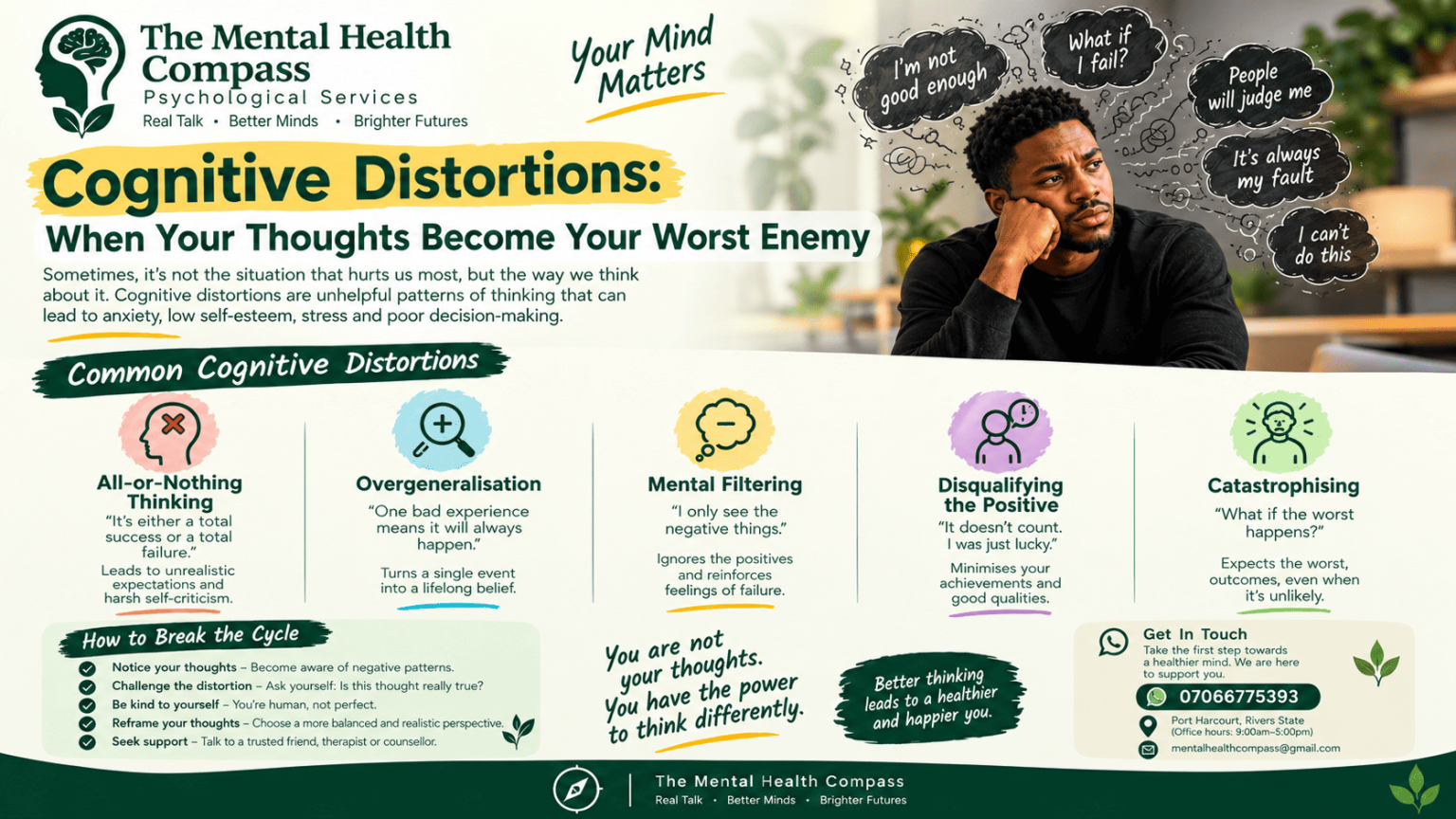

Have you ever made one mistake and immediately concluded that you are a complete failure? Or sent someone a message, received no reply, and decided they must be angry with you? These reactions can feel convincing, but sometimes our minds interpret situations in ways that are harsher than the available evidence supports.
Psychologists call some of these patterns cognitive distortions: habitual ways of thinking that can make situations seem more negative, threatening, or hopeless than they really are. Everyone experiences unhelpful thinking from time to time. The concern is when these patterns become frequent and begin to affect our emotions, relationships, or decisions.
Common thinking traps
Catastrophising means expecting the worst possible outcome. A student who performs poorly on one test may conclude that their entire future is ruined. All-or-nothing thinking treats situations as complete success or total failure: “If I cannot do it perfectly, there is no point trying.”

Mind-reading involves assuming we know what another person thinks without checking. Overgeneralisation means taking one painful experience and applying it to everything: “This relationship failed, so nobody will ever love me.” Labelling turns a specific mistake into a judgement about the whole person, such as “I made a poor decision” becoming “I am stupid.”
- NEMA Advises Nigerians On Safety Measures Against El Niño Risks
- House Of Representatives Considers Bill To Limit Advance Rent In Abuja
- Cognitive Distortions: When Your Thoughts Become Your Worst Enemy
- Nigeria Launches Historic Pan-African Film Campaign
- DEVELOPMENT INSIGHTS MORNING BRIEF 27 OCTOBER, 2026
Emotional reasoning occurs when we treat a feeling as proof: “I feel unwanted, so nobody cares about me.” Feelings are real experiences, but they do not always provide a complete picture of reality.
Psychology Insight
Cognitive behavioural therapy (CBT) helps people notice the connection between thoughts, feelings, and behaviour. The aim is not to force positive thinking or pretend problems do not exist. It is to examine thoughts carefully and develop a more balanced interpretation.
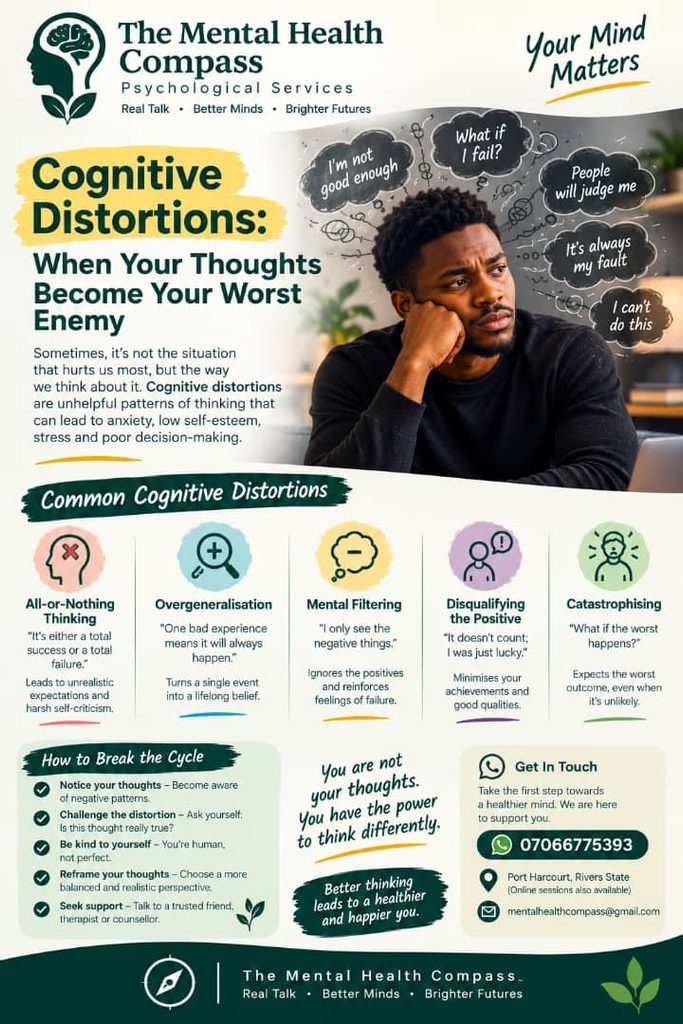
For example, instead of “I failed this interview, so I will never get a job,” try: “I am disappointed that I was not selected. One interview cannot determine my entire future, and I can learn from the experience.” This alternative acknowledges the pain without turning it into a prediction.
A practical exercise
When a distressing thought appears, pause and write down: (1) What happened? (2) What am I telling myself about it? (3) What evidence supports this thought, and what evidence does not? (4) Is there another reasonable explanation? (5) What would I say to a friend in the same situation?
You may not be able to stop every negative thought from appearing, and you do not need to. The skill is learning not to accept every thought as a fact. If persistent distress is affecting your daily life, a qualified mental health professional can help you explore these patterns.
Reflection Corner

Which thinking trap do you recognise most in yourself: catastrophising, mind-reading, all-or-nothing thinking, overgeneralisation, labelling, or emotional reasoning? What is one thought you could examine more fairly today?
Your mind can offer a thought without that thought being the whole truth. Pause, question it, and give yourself room to see the situation more clearly.